Elections in MV and Berlin: The First CDU Elimination and Other Historic Results
The metropolis of Berlin and Germany's most sparsely populated state, Mecklenburg-Vorpommern, differ in almost every respect. Yet they share one thing in common: historic results in yesterday's elections. An overview.
CDU
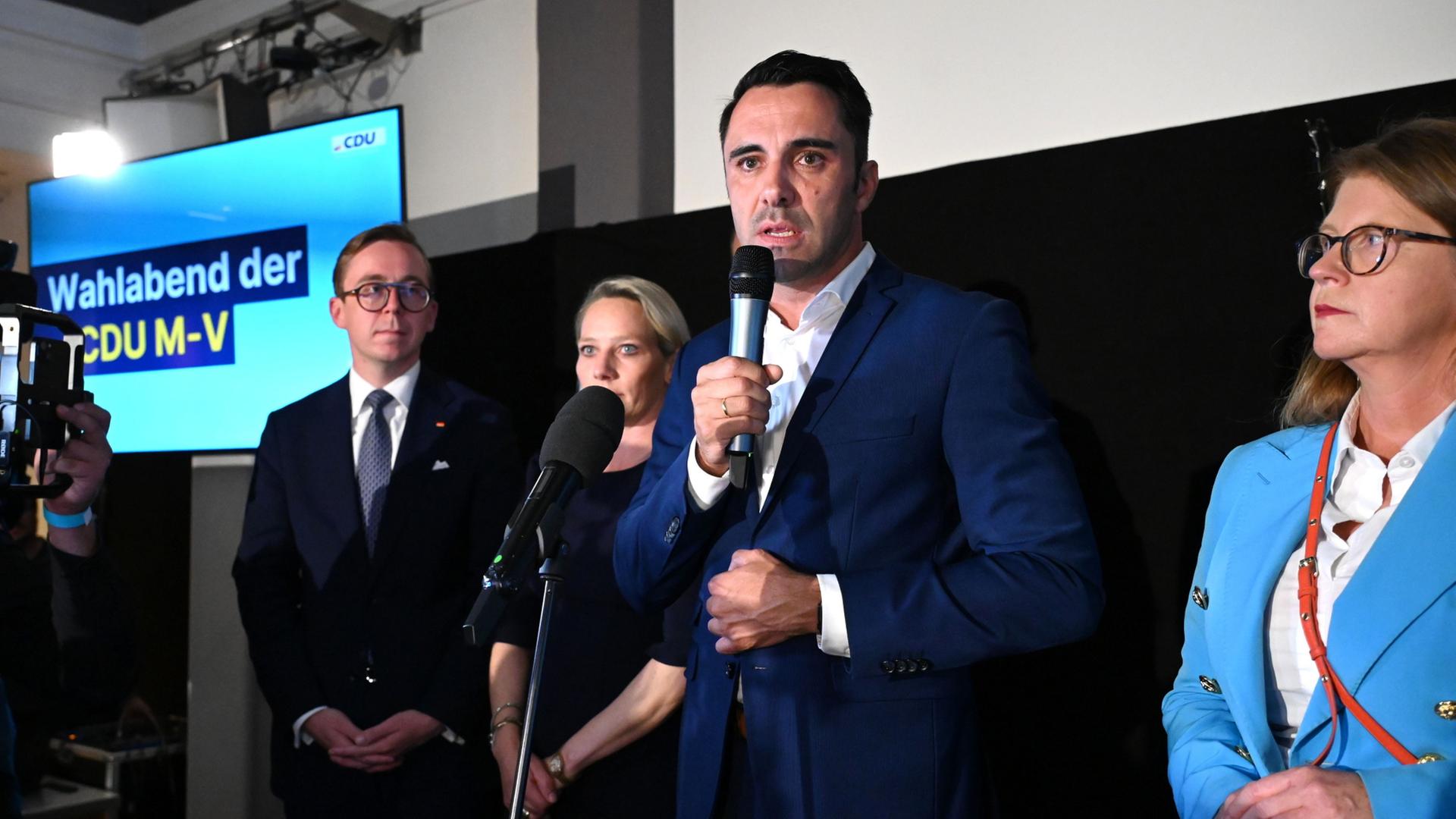
"A disaster" – Chancellor and party leader Friedrich Merz was blunt in his initial assessment of the Mecklenburg-Vorpommern result. Something historic had occurred: his CDU was facing its worst-ever state election result. But the evening grew even more dramatic: with 4.89 percent, the party has for the first time since 1949 failed to clear the five-percent threshold in a state, federal, or European election.
Even though the northeastern CDU has long been one of the weaker regional branches of the party, the previous worst CDU result had come in 1951, when the Christian Democrats received at least nine percent in Bremen – though that was during a very early phase of the Federal Republic's party system. In more recent times, the CDU received 11.2 percent in Hamburg in 2020 and 12.1 percent in Brandenburg in 2024.
This "disaster" has befallen a party that – together with the CSU – has shaped the politics of the Federal Republic like no other, through the eras of Adenauer, Kohl, and Merkel. Currently, the Union is the strongest party in six federal states and the second strongest in eight others. It had never previously come anywhere near the five-percent mark. The SPD is now the only party that has never failed to clear the threshold in a state, federal, or European election.
In Berlin, meanwhile, the CDU's 18.8 percent represents its second- or third-worst result, depending on how one counts. In the 2016 state parliament election it received 17.6 percent, and in the 2021 election that was later declared invalid, it received 18 percent. Results such as the more than 40 percent it achieved in the 1999 election have been a distant memory for some time.
AfD
The columns representing AfD election results have been pointing in only one direction for around four and a half years: upward. Since then, the party has increased its vote share in every state election. In Mecklenburg-Vorpommern, with 38.2 percent, it has not only become the strongest party for the first time but has achieved its best result there by a wide margin. It also won 22 of 36 direct mandates and came first in 654 of 724 municipalities.
Nationally, this is the party's second-best result after the recent 43.8 percent in Saxony-Anhalt. In terms of state election comparisons nationwide, 38.5 percent is a very strong result overall. Better performances have been rare in recent years, achieved for example – alongside Saxony-Anhalt – by the Schleswig-Holstein CDU (43.4 percent in 2022) and the SPD in the Saarland (43.5 percent in 2022).
The party has also never been as strong in a Berlin state parliament election as it was yesterday with 16.3 percent. It won the direct mandate in twelve constituencies, received the most second votes in 16 constituencies, and became the strongest party in the Marzahn-Hellersdorf district with 33.9 percent.
With the preliminary result in the northeast, the party is now the strongest force in three federal states – alongside MV and Saxony-Anhalt, also in Thuringia. In Saxony and Brandenburg it is the second strongest party.
SPD
A year ago in September, the SPD in Mecklenburg-Vorpommern trailed the AfD by 19 points in an Infratest dimap poll. In the end, according to the preliminary result, the gap was 2.7 points. As remarkable as this comeback was, the Social Democrats failed for the first time since 1994 to emerge as the strongest force in the northeast. Their 35.5 percent is an average result compared to previous elections.
In Berlin, however, the SPD result marks a low point for a party that has governed there continuously since reunification and has provided the head of government for most of that time. Whether one counts from 1949 or from reunification, the party has never been this weak here, with its current 12.1 percent. It is now only the fifth-strongest force; three years ago it was still very narrowly the second-strongest party with 18.4 percent, and in the annulled 2021 election — and the four elections before it — it was even the strongest.
Viewed at the national level, Berlin fits into a broader pattern: since the 2025 federal election, every state election has brought partly massive losses — with the recent exception of Saxony-Anhalt, where the baseline was already very low. And before the federal election, things did not look much better.
Die Linke
For the Left Party, it was a day of extremes: in the northeast, it achieved 6.5 percent, its worst result to date in a state election there. The 9.9 percent it received five years ago had itself been a record low at the time.
In Berlin, however, the party achieved something historic: for the first time, it became the strongest force in the capital. Its previous peak was 22.6 percent in 2001 — but at that time it still finished third, behind the SPD and CDU. In the two most recent elections, the Left Party had become the fourth-strongest party with 12.2 percent (2023) and 14.1 percent (2021) respectively.
Nationally, the Left had previously been the strongest force in a state election only once: in Thuringia in 2019. Moreover, Berlin's 25.7 percent is the best result the party has achieved outside the eastern German flächenstaaten — and the eighth-best result the Left has ever recorded in a state election.
The Greens
In Mecklenburg-Vorpommern, the Greens cleared the five-percent threshold for the second consecutive time, and 5.7 percent is their fourth-best result there to date.
In Berlin, the Greens received 14.3 percent, their weakest result since 2006 (13.1 percent). Whereas three years ago they finished third, just narrowly behind the SPD, they are now back in fourth place.
Both results fit into a series of losses across numerous consecutive elections. Only in Saxony-Anhalt two weeks ago did the party record a gain of three points.
BSW
Historical comparisons are barely possible for a very young party. But the BSW has failed to clear the five-percent threshold in both Mecklenburg-Vorpommern and Berlin. Since Brandenburg in 2024 (13.5 percent), the party has now failed to enter a state parliament six times — only two weeks ago in Saxony-Anhalt did it manage to clear the threshold.
FDP
The Liberals have failed to re-enter the Mecklenburg-Vorpommern state parliament. Their preliminary result of one percent is their worst ever in the state — the previous low was 1.6 percent in 1998.
In Berlin, they were already no longer represented in the Abgeordnetenhaus. The current 2.5 percent is around the middle of the national range; in Berlin, the FDP was only weaker in 2011 (1.8 percent) and 1999 (2.2 percent). In 1995, it also received 2.5 percent.
Nationwide, both results continue the party's years-long string of defeats. Until the state elections in spring, it still held seats in eight state parliaments – after being eliminated in the northeast, it is now represented in only four of 16 state parliaments: Hesse, Bremen, North Rhine-Westphalia and Schleswig-Holstein.
Elections will be held in the latter three states next April or May.