War Against Ukraine: Vacation Under Fire on Russia's Beaches
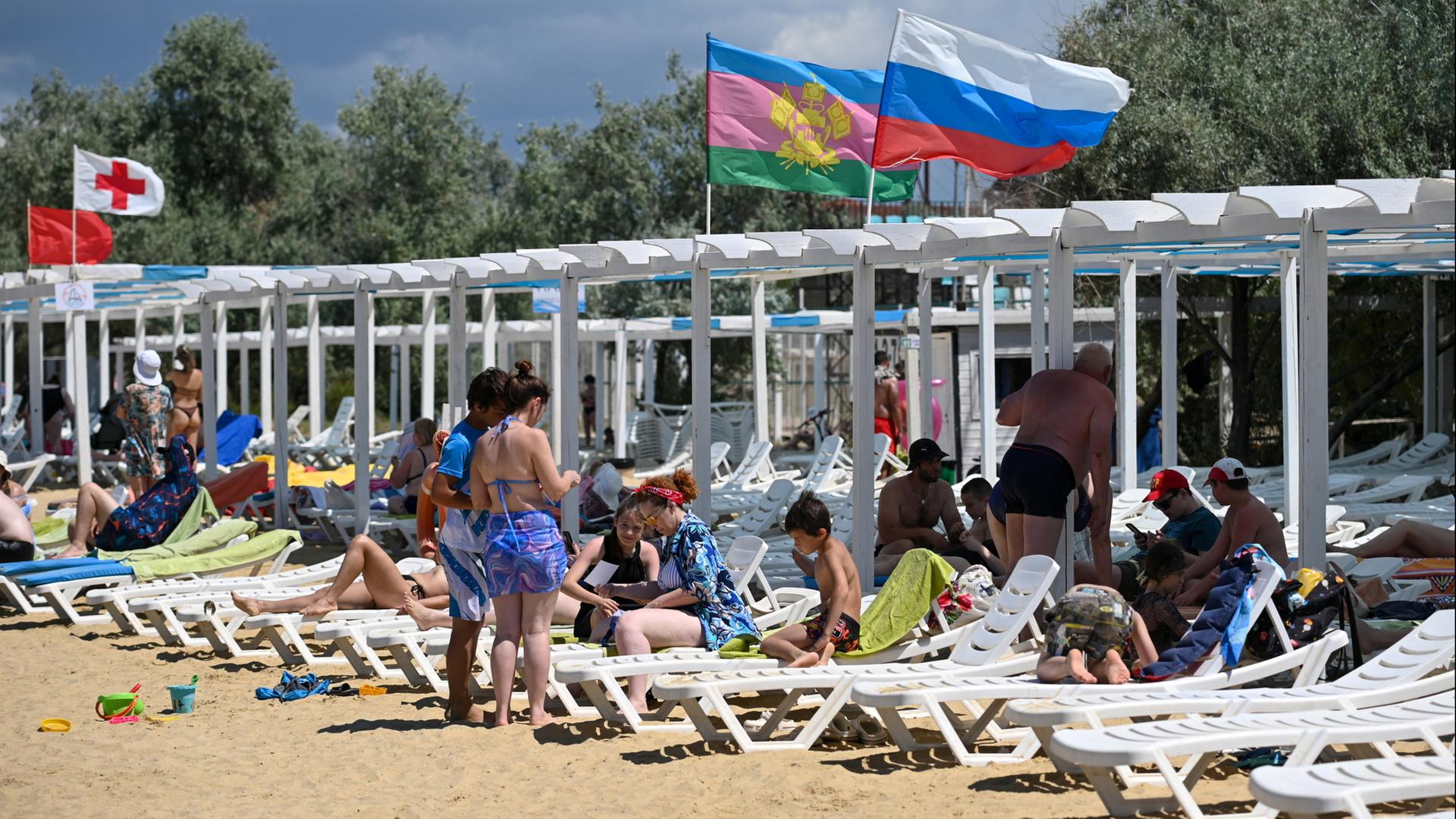
It is summer, and people in Russia are flocking to the beaches of the Black Sea coast. But there are increasingly frequent air raid alerts there — and so the war against Ukraine is making itself felt to Russians even while they are on holiday.
The wind blows fiercely across the beach of Novorossiysk, a port city in the northern part of Russia's Black Sea coast. Some people stroll along the promenade, while others sunbathe in a sheltered corner on the pebble beach.
But then the air raid siren sounds, in the middle of the day. The sound of the sea accompanied by a wailing siren — that is what this summer sounds like here.
Lifeguard Artur picks up his megaphone and politely calls on beachgoers to leave the beach. "I am, in a sense, sacrificing myself to evacuate the beach," he says proudly. This year, his job is harder than ever.
Above all because some people simply refuse to give up their spot in the sun and just stay put. Like retiree Lyudmilla and her friend: the two are sharing a towel and chatting away despite the alarm. Lyudmilla is annoyed: "Why all this fuss when there's nothing to see? They're just terrorizing people with it."
The Russian Black Sea coast and part of the Ukrainian Black Sea coast. The Russian-occupied territories of Ukraine are shown with hatching.
"I think this was only the beginning"
But the danger is very real: in the night of August 12, Ukraine launched a massive attack on the port of Novorossiysk. A Russian naval base is located there. It is also Russia's most important hub for foreign trade, handling oil, grain, and container cargo.
In the large-scale attack, however, it was not only the port area that was hit. Residential buildings in the vicinity were also damaged, and there were fatalities and injuries.
Natasha lives not far from the port, and is currently sitting relaxed in her front garden with her elderly mother. But she cannot forget the night of the attack, she says: "It was very frightening." The whole city did not sleep. Natasha's family has lived here for decades. Her mother recounts how German bombs struck the area during the Second World War. How they roared and whistled. And now again: "We thought the war was over."
But in the night of August 12, there were such powerful explosions. She and her great-grandson had been unable to sleep out of sheer fear. The war has now arrived on their own doorstep, at Russia's summer holiday hotspot. And Natasha fears: "I think this was only the beginning."
Most Important Hub for Foreign Trade
The Ukrainian attacks are hitting the Russian economy hard above all. The port of Novorossiysk is Russia's most important hub for foreign trade. But for days now, everything here has come to a standstill. In the Black Sea, the conflict between Russia and Ukraine is escalating through mutual attacks on ports, energy installations, and civilian cargo ships.
Logistics manager Grigori Polanski points from a distance at the damage to the grain terminals: "The Azov-Black Sea basin accounts for around 80 percent of Russian grain exports." The port of Novorossiysk therefore occupies a key position in Russia for the transport of grain to international markets.
Through mutual attacks on ports, oil installations, and cargo ships, approximately 97 percent of Ukrainian and Russian grain export capacity across the entire Black Sea region is currently blocked.
Drone Crash on the Bathing Beach
About 170 kilometers further south along the Black Sea coast lies the country's most famous holiday camp. Every morning, the Russian national anthem rings out here, as children and teenagers raise the flag. From a Russian perspective, they have drawn the winning ticket: three weeks at the "Orlyonok" camp — translated, it means "little eagle."
Director Alexander Dzheu is enthusiastic about his program: the children learn here to believe in themselves and in their country, to believe that they can change the world — "not through violence and wars, but through peaceful and beautiful deeds." Most of the young people competed in talent competitions for the chance to attend. Others have influential parents. Canceling the camp during these times is out of the question for the management.
A group of young people is currently attending a swimming lesson, but the class must come to an abrupt end: an air raid alarm sounds in the holiday camp too.
Beachgoers had to experience firsthand how serious the threat can be at the beginning of August: a drone struck right in the middle of a crowded beach in the Russian Black Sea resort of Arkhipo-Osipovka, just 25 kilometers from the summer camp as the crow flies.
According to official reports, seven people were killed, including four children. In video footage from social media, gunfire can be heard before the crash, which could indicate that Russian air defenses fired on the drone before it hit the beach. Russia claims the Ukrainian attack deliberately targeted the people on the beach.
Fewer Guests in the Luxury Resort of Sochi
At the far southern end of the Black Sea region lies the quintessential destination for Russian luxury holidays: Sochi, host city of the 2014 Winter Olympics. Not many Russians can afford to vacation here. This year, significantly fewer tourists have made the trip than usual.
But not because of the high prices, says bartender Kira: "It's because there are drones and explosions here. The siren sounds and people are driven away — they aren't allowed onto the beach."
The journey by car is also arduous: fuel is repeatedly unavailable at petrol stations. Authorities have advised people along the coast to only go to fill up in an emergency, if fuel happens to be available. Cars queue in the heat, and vacationers are growing increasingly frustrated.
The war has now reached Russia's holiday paradise as well. And even the way out is uncertain, as airspace for civilian air traffic is repeatedly closed.
You can see this and other reports on Sunday at 6:30 p.m. on Weltspiegel on Das Erste.