Union Faction Consultations: Another Uncomfortable Working Day for Merz
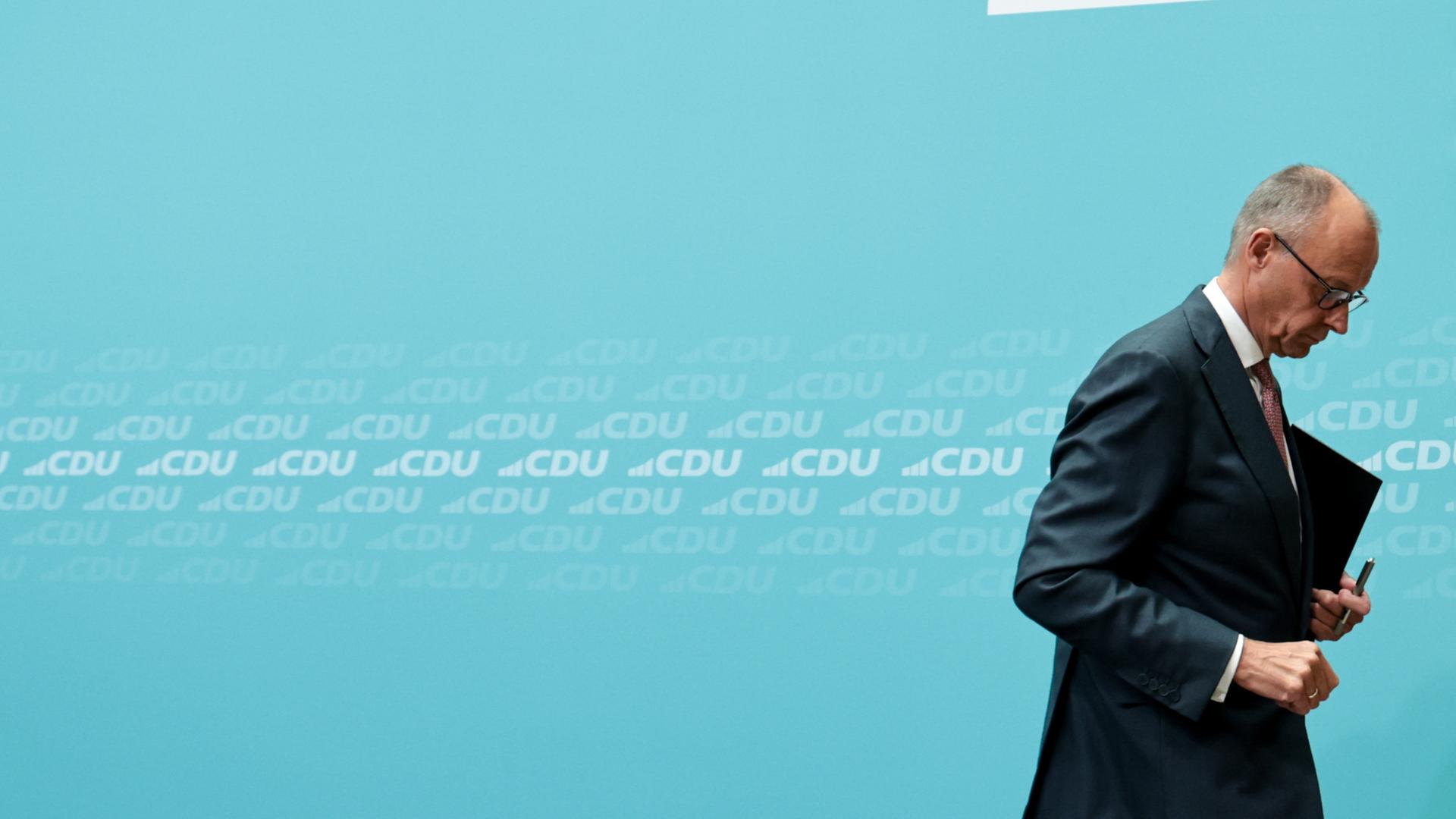
Keep going, but no "business as usual" – that is Merz's course of action. Whether his Union parliamentary group will go along with it will become clear in the afternoon. The Chancellor and CDU leader is facing nervous MPs. Criticism of him shows no sign of abating.
Giving up is not an option for him: Friedrich Merz has made it clear on multiple occasions that, despite his CDU's recent election defeats, he intends to remain both Chancellor and CDU leader and stay fundamentally on a course of reform.
But that is unlikely to bring the debates within the CDU to any kind of conclusion – neither in terms of content nor personnel. In the afternoon – on day two after what, from the Union's perspective, was a catastrophic election Sunday – the parliamentary group is meeting to consult with Merz and possibly also about Merz. The party leader and Chancellor specifically did not travel to the UN General Assembly in New York in order to attend. It is likely to be another uncomfortable working day for him.
"This also has something to do with individuals"
Calls for consequences had already grown louder yesterday – in fact, ever since the Saxony-Anhalt election. Saxony's Minister-President Michael Kretschmer demanded that his party carry out an unflinching analysis and make a fresh start. "This also has something to do with individuals," he said on MDR.
Thuringia's Minister-President and CDU state leader Mario Voigt called the election fiasco a historic turning point. There could be no "business as usual," he said, and what was needed was a "comprehensive audit of Berlin's governing policy," speaking on the sidelines of a CSU parliamentary group retreat at Kloster Banz. The idea that the CDU could be voted out of a state parliament, as had just happened in Mecklenburg-Vorpommern, was "actually unimaginable."
With an eye on the reform course amid simultaneously rising prices, he said: "Ordinary people" must be able to afford ordinary life again. Fuel, heating, rent, housing and groceries had all become too expensive.
Open letter from Großbeeren
Messages also reached Merz from Großbeeren in Brandenburg, a CDU stronghold. "We will not be calling for his resignation at this point," said local chairman Adrian Hepp. He did, however, raise the possibility of separating the party and government offices. "It would have been a viable path to split the party leadership and the office of Federal Chancellor," he told the news agency dpa.
Two weeks ago, Merz had already received a letter from the CDU in Großbeeren: "Mr Merz, leadership is required now!" read the open letter following the Saxony-Anhalt election. So far, according to Hepp, it has gone unanswered. In Großbeeren, a municipality of approximately 9,300 residents, the CDU achieved its best result in the 2024 Brandenburg state election with 22.7 percent.
North Rhine-Westphalia's Minister-President Hendrik Wüst, considered a potential successor to Merz as Chancellor, reaffirmed even after the new election defeats that he does not consider personnel debates productive. "We need a stable federal government," he said at an event hosted by the Rheinische Post. "We simply do not consider personnel debates to be productive or appropriate right now," he said, referring to last week's statement by the eight CDU Minister-Presidents, in which the state leaders had responded to speculation about Merz's future and expressed their support for him.
What about the firewall?
Not only will Merz be unable to shake the debate about his own person, but the firewall discussion is also unlikely to die down in light of the AfD's electoral successes. CSU deputy leader Manfred Weber declared the previous strategy of distancing from the AfD a failure. "We must put an end to a theoretical firewall and finally start extinguishing the fire," he said. The goal should be to expose the internal divisions within the AfD.
CSU leader Markus Söder recently called the existing concept of a firewall the wrong approach. Within the CDU, too, there are repeated calls for substantive engagement with the AfD rather than "demonization."
Less pure CDU?
And then there is the coalition partner. On Monday, Merz thanked the SPD for its willingness to remain in the coalition. However, the Social Democrats are insisting on changes to the reform agenda — meaning less pure CDU, which in turn is likely to cause Merz problems within his own ranks. In Großbeeren, for example, local CDU chairman Hepp warned: "If Mr. Merz continues to let himself be dominated by the SPD, this is truly the beginning of the end. We will be ground down by it."
"We need to reinvent ourselves," Merz said yesterday at CDU headquarters. That would be nothing less than a fresh start from a deep crisis. First, however, the parliamentary group of the Union wants answers from Merz today. "They want to see where the journey is headed," political scientist Thorsten Faas said on ARD's Morgenmagazin. Failing to enter the state parliament in Mecklenburg-Vorpommern "has an effect on the members of parliament." Political existences are at stake. "Something like that makes a party very, very nervous."
Whether Merz can provide reassurance in these turbulent times remains an open question. The meeting is scheduled to begin at 3 p.m.