Election Arena in Berlin: Between Exchanges of Blows and Exploratory Talks
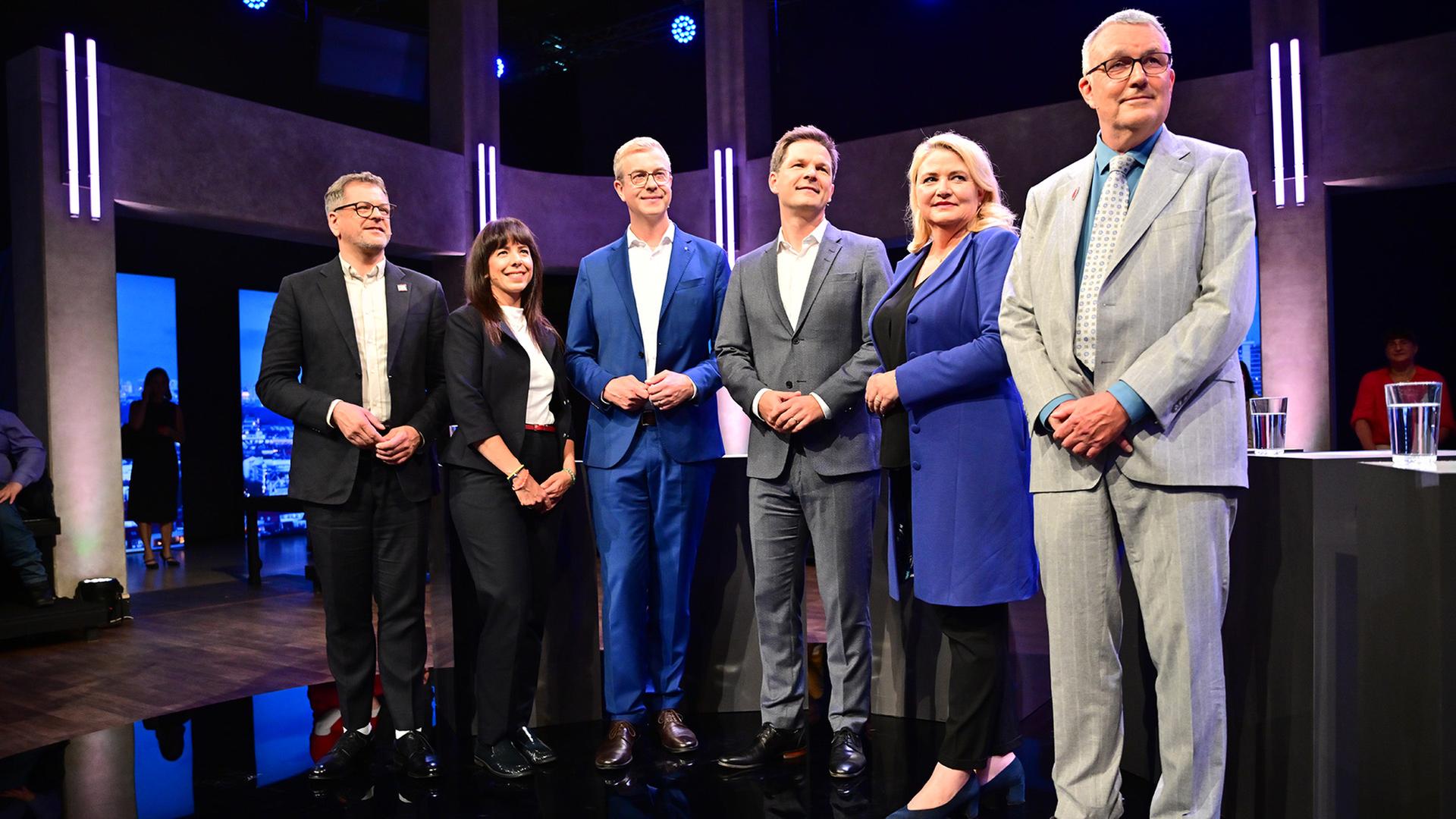
Just days before the Berlin election, six leading candidates faced questions from the audience in the election arena. The debate revealed some clear differences that could cause post-election talks to break down.
If success at the rbb24 Wahlarena were measured solely in coalition offers, the winner would be clear: Werner Graf. By the end of a at times heated debate, the Greens' lead candidate had collected no fewer than two such offers. "I would very much like to form a coalition with Werner Graf," said Left Party lead candidate Elif Eralp. "Working with Werner Graf would be an excellent collaboration," SPD lead candidate Steffen Krach also stressed. And Graf happily accepted both offers: "It would be great for Berlin to have a progressive government," said the 46-year-old.
This by no means suggests, however, that a red-green-red government is already a foregone conclusion after September 20: the SPD and the Left Party also revealed some notable differences that could cause this constellation to fail in coalition negotiations. Krach maintained his opposition to the socialisation of housing corporations — and delivered what was arguably the most memorable line of the evening when he called Eralp the "Friedrich Merz of the Berlin election campaign," because, in his view, the Left Party politician was "promising everything to everyone." What was needed instead was more oversight and the prosecution of unlawful rents, Krach argued.
Housing Policy: Between "Law and Order" and a "Rent Cap"
Here, CDU lead candidate Stefan Evers made clear that his party's law-and-order mantra could equally be applied to the housing market. "Law and order belong in tenancy law just as much," said Evers. The incumbent Senator for Finance and Culture also took up the Greens' proposal to convert vacant office buildings into residential space. "I have absolutely nothing against that — I even think it makes sense." Whether he would also help fight at the federal level for the rent cap demanded by the Greens and the SPD for Berlin, however, Evers left open. This could prove a sticking point in any potential black-green-red negotiations over a Kenya coalition.
For Kristin Brinker of the AfD, such considerations were already irrelevant before the rbb24 Wahlarena: her party currently has no coalition partners in Berlin politics. She herself would speak with anyone who "carries Berlin in their heart," said the 54-year-old. Her attempt to find at least some common ground with Evers on transport policy — by raising the magnetic levitation railway favoured by the CDU — came to nothing.
Evers did not engage with it and emphasised at the end of the programme that he would "under no circumstances work with radicals." From Evers' perspective, this also includes the Left Party, whom he has repeatedly accused of antisemitism during the campaign — not Eralp personally, he stressed, but parts of her party, particularly in the Neukölln district.
Middle East Conflict as a Significant Issue
Just how much this issue preoccupies the city was also made clear by the audience in the election arena: one viewer attempted to distribute Stars of David to the lead candidates during the broadcast to draw attention to a solidarity campaign, and another audience member confronted Left Party candidate Eralp with calls for an intifada made by a musician at a campaign event organised by her party in Neukölln.
"It is completely clear to me that calls for violence are unacceptable," Eralp defended herself, emphasizing once again that she wants to protect Jewish life in Berlin. "I believe you that you personally do not hold antisemitic views," interjected CDU politician Evers. However, what happened in Neukölln was not an isolated incident, and Eralp apparently lacked authority within her party. "I expect a clear stance, consistency and decisive action," said Evers, "at least from someone who claims to be entitled to participate in governing this city."
Controversial Symbolism
The most memorable moment of this debate, however, was provided neither by Eralp nor by Evers, but by Michael Lüders. Bündnis Sahra Wagenknecht (BSW) had sent the official number 2 on their state list to the rbb24 Wahlarena. The publicist and Middle East expert appeared with a striking pin on the lapel of his jacket: it showed an outline of Israeli state territory, colored like a watermelon. "A symbol of the Palestinian will to resist," Lüders explained.
The Federal Office for the Protection of the Constitution, however, classifies it as belonging to "secular pro-Palestinian extremism," because the image denies the State of Israel its right to exist. Lüders evaded critical follow-up questions from moderator Sascha Hingst during the broadcast.
His offer to hold coalition talks after the election with all those who seek solutions in a "reason-oriented and results-oriented" manner was answered by only one candidate — SPD candidate Steffen Krach. With a clear: No.
Broadcast: rbb Fernsehen, 16.09.2026, 20:15 / Video: rbb Fernsehen, 16.09.2026, rbb24 Wahlarena