Duma Election in Russia: Everything Under Control - And Yet a Stress Test?
Russia's parliamentary election has begun. Parties that criticize the war in Ukraine are not permitted to participate in the three-day vote. Yet the performance of individual candidates could send a signal.
In the last session before the Duma election, its speaker Vyacheslav Volodin apparently felt it was important to once again emphasize the parliament's unity. The government and opposition had worked together excellently during the past legislative period.
"For meeting current challenges, the cohesion of society and political forces is more important than ever," he stressed. "We have done everything to rally behind our country's development agenda, behind our president's agenda. 68.5 percent of all laws were passed with the support of all factions."
This unity must be preserved in the future despite differing views, Volodin said. In other words: fierce political confrontations or even an effective opposition are nowhere to be found in the Duma.
Almost Everything Revolves Around the Ruling Party
The election campaign presented a similar picture. On state-controlled television, approximately three quarters of political airtime went to the ruling party United Russia. Several candidates simply stayed away from televised debates.
Yabloko, the only party to openly position itself against Russia's war in Ukraine, was not admitted to the election due to alleged violations of party financing rules. Only a few individual Yabloko candidates are permitted to run.
Denis Volkov from the Levada polling institute does not expect any surprises in the election outcome in an interview with the ARD studio Moscow: "There will be no significant changes. The mood in the country closely resembles that of five years ago, both in terms of polling figures and approval of the government, as well as the assessment of the economic situation."
Problems Are Attributed to the Ministries
The struggling economy, high inflation, and occasional fuel shortages resulting from Ukrainian drone attacks are indeed concerns for many voters. Nevertheless, Volkov is reluctant to describe this as a vote on Kremlin chief Vladimir Putin. By and large, the population continues to stand behind his foreign policy course.
"Many people support Putin's foreign policy actions in Ukraine and the independent foreign policy course he pursues," Volkov observes. "Economic developments, on the other hand, are viewed considerably more critically. Geopolitical issues are primarily associated with Putin. For this he receives the approval of a majority. Problems in the economy and everyday life, however, tend to be attributed to the government and the ministries. That is why their approval ratings are significantly lower than Putin's."
Remarkably, Putin has to this day not even become a member of the ruling party United Russia. He is always said to be close to it. Nevertheless, the Kremlin chief considers the vote important – shortly before the election, he called on the population to participate. In these times, when soldiers were doing difficult combat work on the battlefield, it was a civic duty: "Your choice and your will shall once again show that our fighters have millions of people behind them, that we are a united people, united by common values, historical memory and love of the motherland."
Predetermined targets must be met
The Kremlin is intent on leaving nothing to chance in this election and on keeping tight control over the future composition of the Duma. The exclusion of the only viable opposition party, combined with the arrests and detentions of candidates in the run-up to the vote: political competition remains severely restricted.
But if elections cannot bring about a change of power anyway, what is the point of all the effort? Observers such as political scientist Yekaterina Schulmann speak of a stress test for the system. The target figures for the election result and turnout set by the presidential administration must be reliably achieved.
Russian-American political scientist Nina Khrushcheva even considers the vote a grand piece of theatre. Whether United Russia ultimately receives 50, 60 or even 70 percent of the vote depends solely on what result the Kremlin still considers credible, says Khrushcheva. "Ultimately, everything depends on what the Kremlin considers plausible at any given moment. What is clear, however, is that the result will be well above 50 percent. The party will be the strongest force in the Duma – there is no doubt about that."
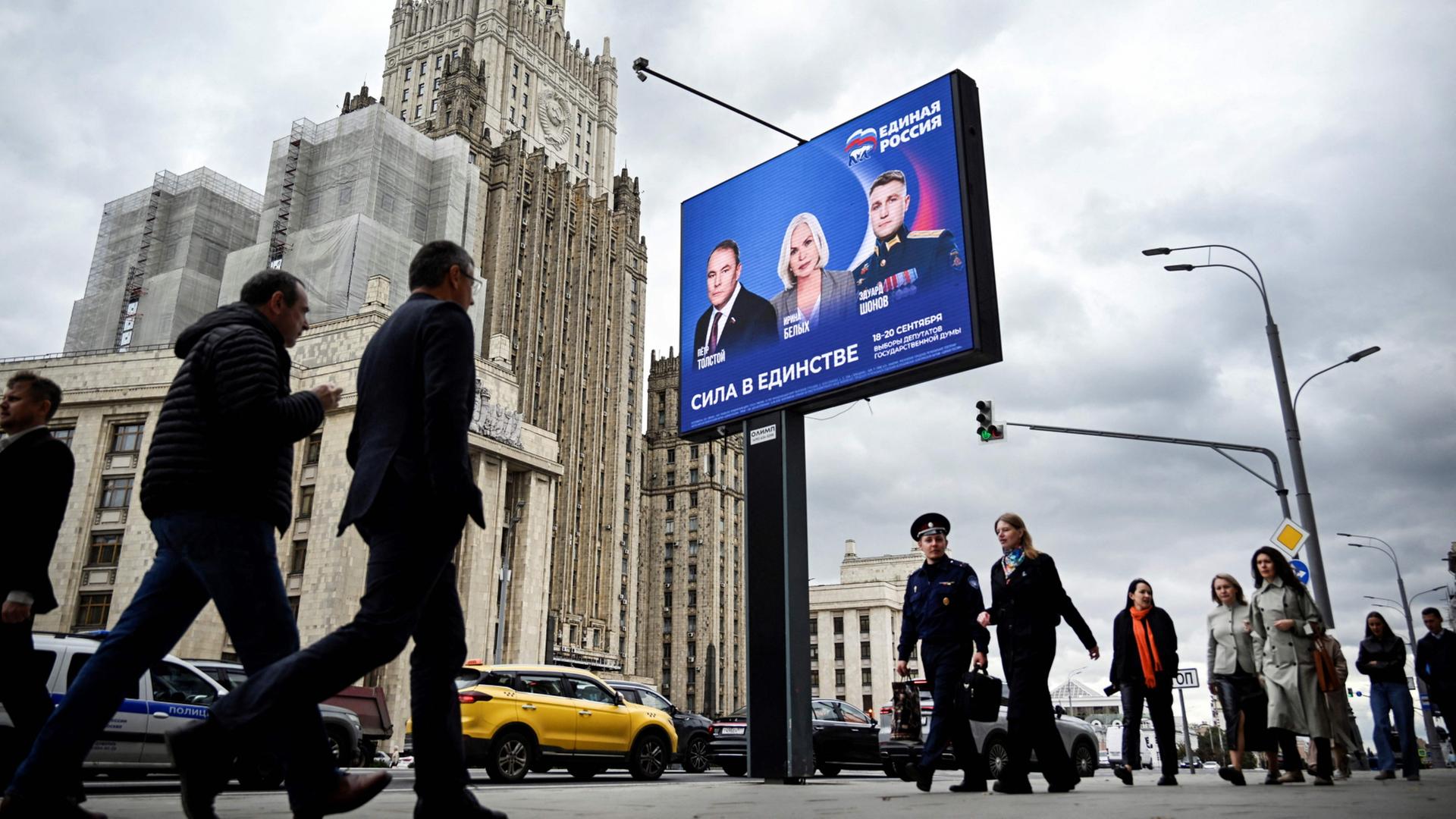
Advertising for the ruling party United Russia is omnipresent in Russia these days. The opposition, by contrast, rarely appears even on television.
Will individual opposition members enter parliament?
What is genuinely suspenseful, at most, is the performance of the remaining Yabloko candidates – and the question of whether, in the event of electoral success, they will actually be able to take their seats in the Duma, or whether obstacles will be placed in their path at the last moment.
Yabloko leader Nikolai Rybakov called on voters in constituencies where no Yabloko candidates are standing to deliberately spoil their ballot papers by placing a cross next to every party on the list.