"I don't know whether I have to put up with it or not, whether I have to normalize it or not. I just don't know." Anas Aouin (Tetouan, 20 years old) arrived in Spain through Ceuta in 2021, as a teenager, in the last mass crossing from Morocco before the one that took place this summer. He came pursuing a dream that is now a reality: papers, a job — at a restaurant in the port of Málaga, he says with pride — a life in Spain. There have been setbacks and hardships along the way. Not only three years in a youth care center. There has also been racism from "a part" of Spain. "Just one part," he stresses. But "more now" with "the Ceuta situation." "Nasty comments," he summarizes, in simple, confident Spanish with a strong accent. In his day-to-day life he does his best to brush them off. That is what he calls "normalizing it." Although it still doesn't seem normal to him. It doesn't seem normal to him to watch the language grow increasingly heated, especially on social media, sheltered by anonymity. "I read things like 'we have to kick them out of here.' But we're also the ones building this country!" he protests.
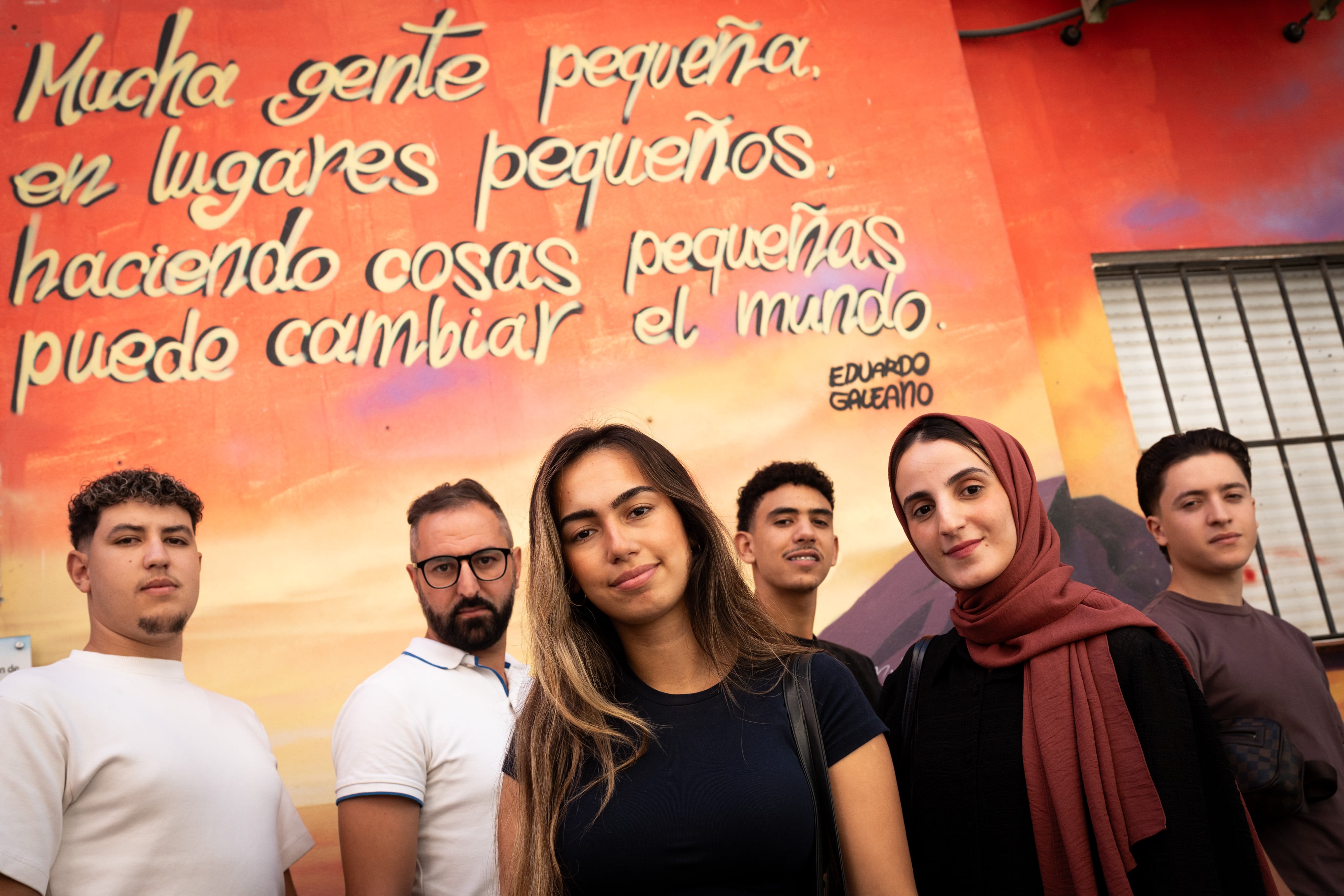
Beside him, Bilal El Hichou (Belyounech, 20 years old) and Usam Elmakouti (Tetouan, 18 years old) nod in agreement. They also arrived through Ceuta as minors and have also ended up working in the hospitality industry in the capital of the Costa del Sol. They are three of the six people born in the North African country who sit down with EL PAÍS this Tuesday to talk at the Málaga headquarters of the Moroccan Association for the Integration of Immigrants. Several questions shape the conversation. How are they experiencing the Ceuta crisis, which often leads to their country being portrayed as an "invader" and their compatriots as "invaders"? What do they think? What do they fear?
Several dominant ideas emerge from the conversation, which will reappear among the 13 testimonies included in this article. The first is that the atmosphere surrounding Moroccans living in Spain has grown more hostile. This is the view of Lina Kajaj, a psychologist who is still studying while looking for work. Born in Tetouan 23 years ago, her loose blonde hair means many people do not imagine she is Moroccan. This allows her to hear more than other compatriots what is being said about them. And what conclusion does she draw? That the crisis "is really noticeable." "It's Ceuta all day long, Ceuta, Ceuta... And then on TikTok... It's all 'get the Moors out,'" she laments. The Ceuta crisis has triggered the largest peak of xenophobic hate on social media since the riots in Torre Pacheco (Murcia), with Muslims as the primary target, according to the government's anti-racism observatory.
There is also a widespread fear that life will become harder. "I'm here to study — what's my fault in any of this? This is going to hurt people who haven't done anything wrong," laments Lina, who is also worried that a possible deterioration in relations between Spain and Morocco could make it harder to renew residency permits. Farah Achedil (Nador, 25 years old), a Spanish language student currently in the process of regularizing her status, expresses a similar concern.
At the table, where there is little appetite for talking politics, a criticism emerges of the media's handling of the crisis, above all because it does not address — several of them feel — the reasons behind such an influx. "On television, nothing comes from the other side, from Morocco. What lies behind it is very painful," says Lina. At 36 years old, Fahde El Bakkali, also from Tetouan and a mediator at the association, emphasizes one reason for the mass crossing that he sees as both crucial and ignored: the idealization of life in Spain held by part of the Moroccan population.
"From a young age, that idea is drilled into our heads: Spain, Spain," he says, mimicking a hammering motion. That is why he finds it so unfair that newcomers are seen as hostile to Spain, when the majority of them — he says — carry an idealized image of the country taken to an extreme. Anas agrees, and even questions whether he should share images on social media showing himself enjoying his life in Málaga, because they might encourage other young Moroccan boys to follow in his footsteps.
— So, was it not worth it?
— I'm doing well now. But it was very hard. You go through a lot, at such a young age... — he replies. Remembering his own helplessness when he arrived, he grows irritated seeing how influencers now swarm around Ceuta "creating content" at the expense of people who "don't even speak the language."
More than one million
Anas, Bilal, Usam, Lina, Farah and Fahde are part of an immense community. Those born in Morocco and residing in Spain total nearly 1.17 million, according to 2025 census data. This is a number that has been rising since the 1970s, when the tightening of entry into France first swelled the flow toward Spain, explains sociologist Andreu Domingo, deputy director of the Centre for Demographic Studies. No other foreign country contributes as many registered residents. Nearly three-quarters are concentrated across Catalonia — which has the most — Andalusia, the Valencia Community, Murcia and Madrid.
Contrary to the popular belief that many reside in Spain irregularly, a Funcas report estimated the number of those in this situation at the start of 2025 at 20,693, well below those arriving from countries such as Colombia (close to 290,000) or Peru (more than 107,000).
Less concentrated in large metropolitan areas than the Latin American population, the Moroccan community constitutes Spain's main foreign workforce. In August, an average of more than 407,000 Moroccans were registered with Social Security, with more than half employed across agriculture (26.05%), construction (16.3%) and hospitality (13.85%).
Risk of "withdrawal"
These are figures that are often overlooked regarding a community facing many obstacles. A historic "mutual distrust" between Spaniards and Moroccans fuelled by their identity-based nationalisms is compounded by the "stigma" surrounding the Muslim world following 9/11 and the 11-M Madrid bombings, analyses sociologist Andreu Domingo. These are not the only disadvantages compared to Latin Americans, who not only share a language with Spaniards but also need just two years of residency to obtain Spanish nationality — and with it the right to vote — versus ten years for Moroccans. On top of that, Moroccans are a preferred target of xenophobic rhetoric.
In a politically unwelcoming environment — with Vox openly using the derogatory term "moro" and the PP expressing its preference for Latin American immigrants, with both parties agreeing wherever they govern together to put an end to the teaching of "Moroccan culture" — the Ceuta crisis has now arrived. Domingo is concerned that, in a climate marked by the force of anti-immigration messages and a hardening of social attitudes toward immigration, the use of the Ceuta emergency against the Moroccan population could lead to "the worst." What would that be? "A community withdrawal," which would further hamper the integration not only of those arriving from Morocco, but also of their descendants born in Spain.
Tension, insults
In 2021, there were almost 325,000 people under 25 born in Spain to one or two Moroccan parents, more than 3% of the total in that age group. One of them is Malak Ezzaanouni Aouzi (Badalona, 21 years old), daughter of Moroccan seamstresses, accustomed to seeing that many Spanish people do not consider someone like her — who wears a hijab — a compatriot. "I am neither 100% Spanish nor 100% Moroccan," summarises this Early Childhood Education student. The Ceuta crisis sharpens that tension. "I feel in the middle, between the Moroccan community and the Spanish one. If the subject comes up, I'm on alert and I have to keep justifying myself. They lump me in with a group I don't belong to," she explains.
Like Aouzi, Awàtef Ahmittach (Tangier, 32 years old) also wears a hijab. A resident of Palafrugell (Barcelona), the birthplace of Josep Pla, she went a few days ago with her sister to the cinema in Platja d'Aro (Girona) to see Cronos, the film that commemorates the jihadist attacks in Barcelona and Cambrils in 2017, in which both of them appear as extras. They had a difficult time. "When we walked in, everyone turned to look at us. And when we sat down, a couple started shouting 'daughters of bitches' and 'terrorists' at us," she recalls.
Having arrived in Catalonia at the age of 11 through family reunification, Ahmittach has experienced racism since childhood. "When little groups form, Moroccan children tend to be excluded. If someone wants to hurt you, the easiest comment is 'dirty Moor,'" she says. But the cinema incident shows, in her view, that animosity is growing. Just as the social reaction to the Ceuta crisis demonstrates for her that "hatred of Moors" is intensifying. "There have always been people who have put me in difficult situations. But now those people feel more emboldened, because they have the support of parties like Vox or Aliança Catalana," she states.
Another person who has experienced some "very hard" moments in recent weeks is Ayman Drin (Tangier, 29 years old), a surveyor living in Málaga, who has on occasion even felt "forced to defend himself." "It frightens me how Moroccans here will be received from now on," he reflects. Engineer Majid Benkinare, a year older than Ayman and also from Tangier, is equally troubled by what he sees and hears in Madrid. Having always noticed "micro-racisms" — such as changes in someone's expression after learning his country of origin — he "increasingly" perceives people as "more emboldened" to make xenophobic judgements, a phenomenon he believes is linked to a worsening perception of Morocco.
The word "invader"
"I have never experienced this in my life, it is unbearable," says Mohamed El Harrak (Larache, 28 years old), a social worker in Cádiz who arrived in Spain at the age of eight hidden in the undercarriage of a lorry and who, turning the pejorative term on its head, calls himself an "ex-unaccompanied minor." By "unbearable," he is referring to an anti-immigration discourse that "keeps seeping in and seeping in." "It's everywhere. In the café, at work, the supermarket, BlaBlaCar..." lists El Harrak, who in the wake of the Ceuta crisis watches with alarm as the word "invader" circulates. "It is not a geopolitical word — it affects ordinary people from a community with little capacity to raise their voice, who are suffering great anxiety."
"Invader" is a term commonly used in the insults that Youssef Ouled (Al Hoceima, 33 years old) receives on social media. He is the coordinator of AlgoRace, a team that investigates the racist use of artificial intelligence. And it is a term that, in his view, has serious implications. "With the Ceuta crisis, the ground is fertile for supremacism. The hatred we were already experiencing rises to stratospheric levels. There is a logic of dehumanization. If you present human beings as invaders, or as weapons, it is impossible to defend their rights. Weapons have no rights. And if those who come from where we come from are invaders, so are we, and anything goes against us," he elaborates.
A retired cook aged 62, Noreddine Lameghaizi has noticed "no change in the way he is treated" due to what happened in Ceuta, which to his surprise was barely receiving any attention in Morocco when he traveled there in August. His experience of normality is consistent with all the time he has spent in Spain. Almost half his life. First in Madrid and then in Valencia, where he and his partner opened the Moroccan restaurant Dukala.
He had previously been in Belgium. And, by comparison, he does not see Spain as a racist country. Not even now, with the Ceuta crisis. Although some Moroccan friends — he says — have conveyed to him the impression that "people look at them badly" in the street. "Perhaps before they didn't pay as much attention either," suggests Lameghaizi, who does affirm that there is among Moroccans a diffuse "fear," which leads to a watchful attitude when problematic situations arise involving an Arab or Muslim country.
With information from Jesús García Bueno, Ferran Bono, Milagros Alonso and Ana María Bosch Pla.