CDU Before the Elections: The Chancellor's Job Is on the Line
Friedrich Merz's future depends on the elections in Berlin and Mecklenburg-Vorpommern. If the CDU falls significantly short of its targets, things could get uncomfortable for the Chancellor. His potential challengers are still holding back.
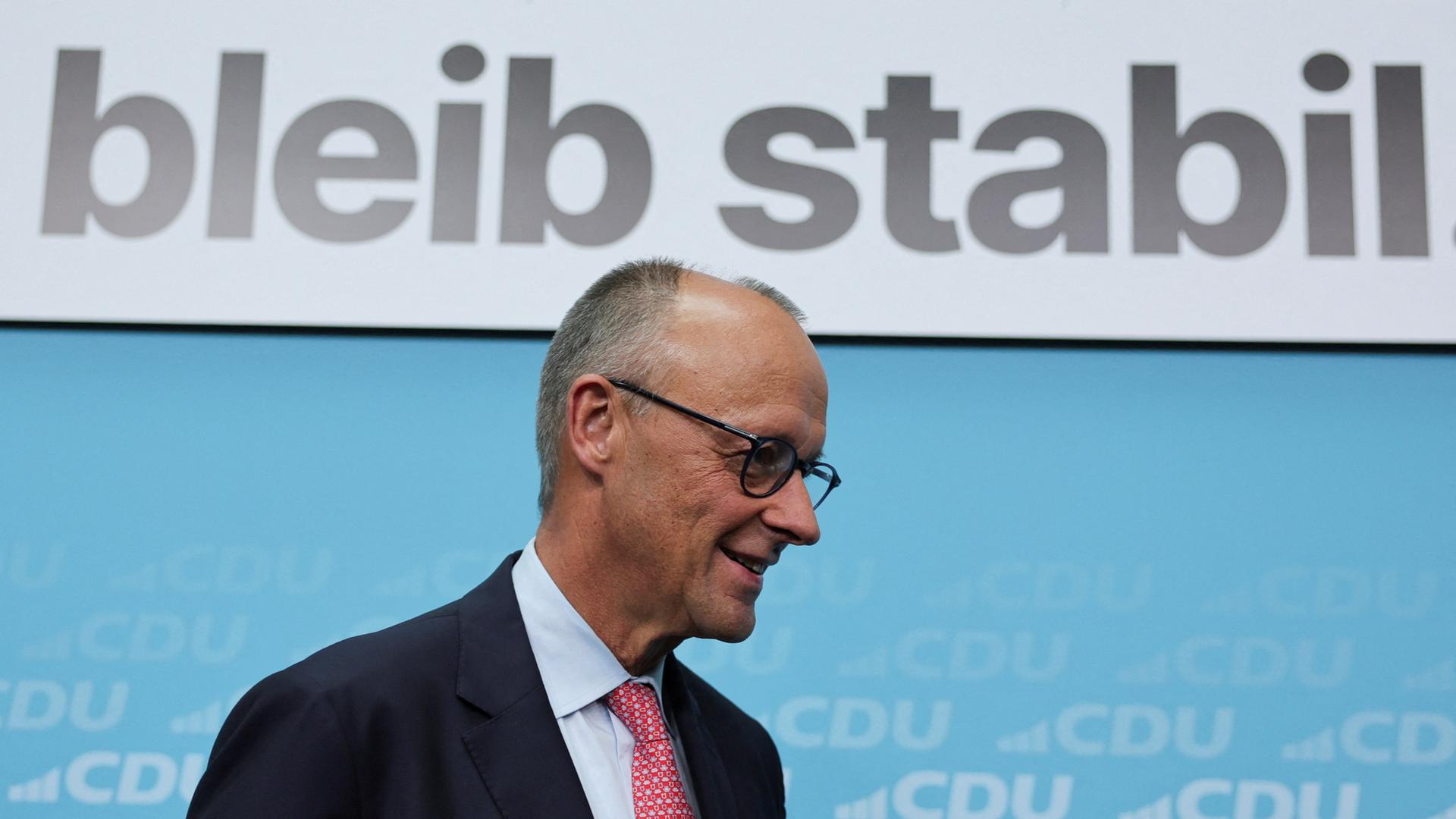
"Berlin, stay stable" reads the signs handed out to the audience at the Konrad Adenauer House. Federal Chancellor Friedrich Merz has come to motivate CDU members for the final push of the campaign. Yet many here are wondering how stable Merz's chancellorship actually is.
"On Sunday, we will be watching Berlin above all," Merz says from the stage. With that, he makes his strategy for election night clear: draw as little attention as possible to Mecklenburg-Vorpommern, where the CDU could end up in single digits. He wants to keep the focus on Berlin, where his party has a good chance of moving back into the Rotes Rathaus.
Dutiful Applause for the Chancellor
This is one of the few campaign appearances Merz has made this autumn at all. And this Thursday evening event is typical: the Chancellor speaks in a sheltered setting, before a sympathetic audience.
Yet even the supporters here seem noticeably more enthusiastic after the speech by Berlin's lead candidate Stefan Evers. When Merz finishes, they rise to applaud more out of a sense of duty than genuine excitement. After all, cameras from international media are watching. The new episode of the ARD political podcast Berlin Code analyses how much this reflects the mood within the party.
In the candidate's shadow? Enthusiasm for Friedrich Merz is limited.
Merz's Future Hinges on the State Elections
At market squares and outside train stations, the CDU grassroots members are sensing a pronounced anti-Merz mood. During the Berlin campaign, it was even noticeable that many CDU stalls were barely recognisable as such: candidates put up umbrellas bearing no party logo and handed out pens bearing only their own names.
All of this looks as though the party is hiding itself and its Chancellor. After roughly a year and a half in government, that is a disastrous record. That things cannot continue this way has by now become consensus within the Union. There is only debate, rumour and alleged coup plotting about what the path out of the crisis looks like.
One thing is clear: the outcome of these state elections will determine the Chancellor's future, particularly in the short term. The question is: can he carry on a little longer? Or does he need to be replaced as quickly as possible? That the CDU will not go into another federal election with him as their candidate is, in any case, already considered a foregone conclusion.
Will Things "Blow Up" After the Elections?
From the Union's perspective, the coming election Sunday would be a success if the party becomes the strongest force in Berlin and does not lose too many percentage points in Mecklenburg-Vorpommern. In 2021, the CDU won 13 percent in the northeast. This time, anything close to ten percent would already be very good.
An election victory in Berlin would be important if only because the CDU has a remark from AfD leader Alice Weidel ringing in its ears: "The CDU will never win another election," she crowed after the AfD's victory in Saxony-Anhalt. "What is happening to the CDU is exactly what I have been predicting for years." It would be good for the party's soul to disprove that prophecy as quickly as possible.
But if, for example, the Left Party becomes the strongest force in Berlin and the CDU slips below five percent in Mecklenburg-Vorpommern, then, as is repeatedly said internally, "the place is on fire." In that case, strong momentum could emerge on election night and the following Monday that would push the Chancellor out of office prematurely.
The Chancellor's challengers are undecided
Because Merz knows that the stakes are high, he has invited people to a CDU presidium meeting at the Konrad Adenauer House on election night. One can assume that he will watch the projections on television from 6 p.m. onwards together with several state premiers. Afterwards, they are likely to agree on a joint communications strategy. How much individual CDU leaders diverge in nuance or fundamentally will be one of the intriguing questions on election night and in the days that follow.
Paradoxical as it may sound, the harsh prophecies of AfD leader Weidel have to some extent also produced the opposite effect. "Your time is up," she called out to Merz in the Bundestag a few days ago. Who within the Union would want to play a part in making Weidel look like a CDU clairvoyant? In the event of an imminent change of chancellor, she could triumphantly declare: Look, my predictions are coming true immediately.
What still supports Merz is the indecisiveness of his challengers. None of the state premiers being touted are yet willing to come out into the open — not before knowing that they would have large parts of the party behind them.