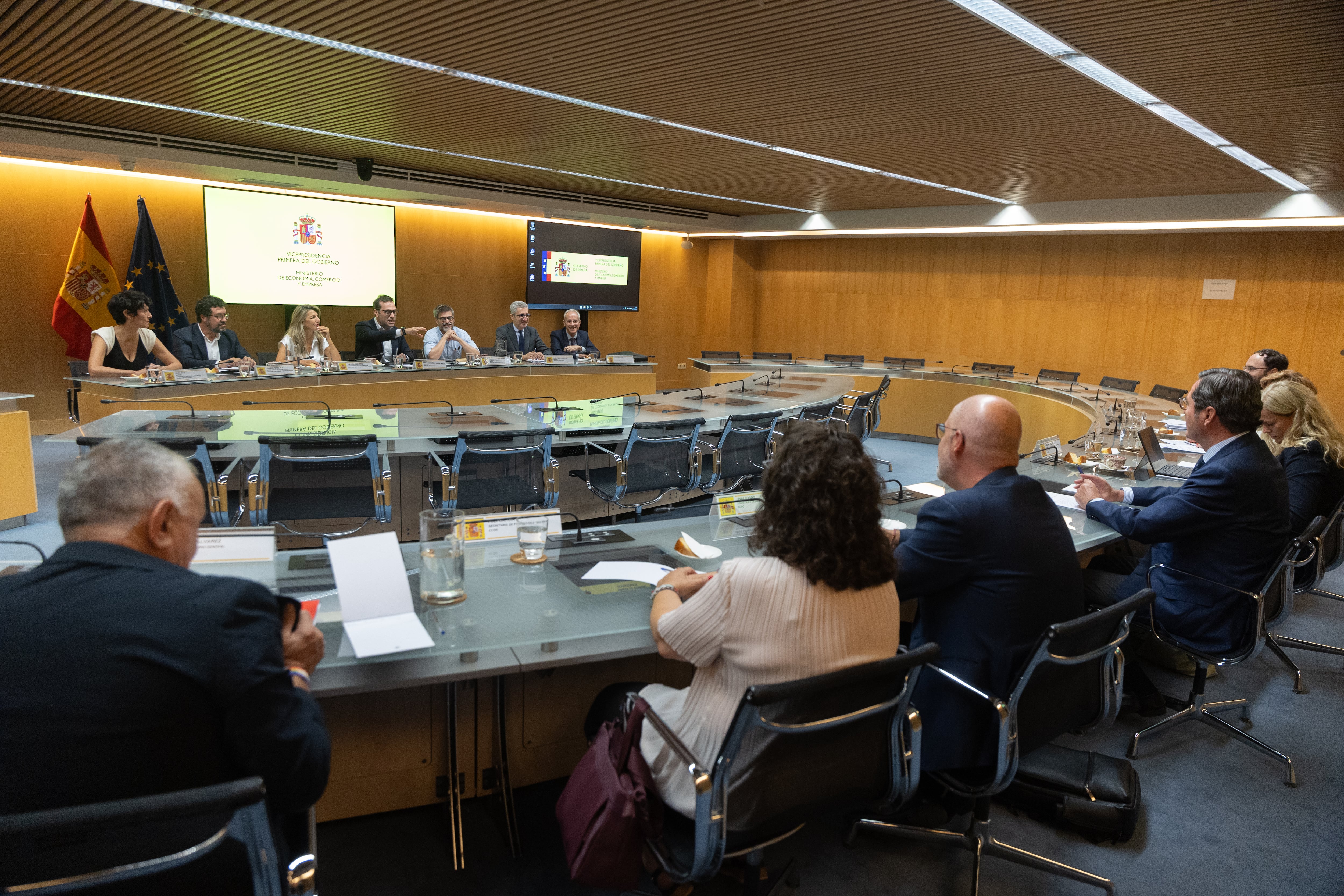
The Government and social partners met on Thursday to analyze the current situation and debate what measures to take when, at the end of this month, the anti-crisis shield implemented to mitigate the economic impact of the war in the Middle East ceases to be in effect. As expected, faced with a scenario that has deteriorated rather than improved, the Executive has expressed its support for extending the aid measures beyond September 30, although it has not specified whether this will involve an extension of the existing package or a different framework, nor whether it will have a broader scope or consist of more targeted initiatives.
This was announced during the meeting by First Vice President and Minister of Economy Carlos Cuerpo, who stated that "the Government will work on the measures of the Response Plan to continue accompanying and supporting families in the face of rising prices." The First Vice President also added that special attention will be paid "to the most affected professional sectors, such as transport and agri-food, due to the effect this produces on the rest of the supply chain," according to sources from his department.
The situation is far from encouraging. Oil prices are flirting with 100 euros amid a conflict that has become entrenched and spread to other regions in recent months. Inflation rose in August to 4.3%, the highest level since 2023, driven by fuel prices, while gas prices have surged and are beginning to feed through to electricity, which since the July heatwave has been trading above 100 euros per megawatt-hour on the wholesale market.
The meeting, held at the Ministry of Economy, was also attended by Second Vice President and Minister of Labour Yolanda Díaz, Minister of Finance Arcadi España, and Minister of Inclusion, Social Security and Migration Elma Saiz, on the Government's side. Representing social and economic partners were CEOE president Antonio Garamendi, Cepyme secretary general María Teresa Gómez Condado, UGT secretary general Pepe Álvarez, and CC OO secretary general Unai Sordo. Both the first aid package, approved in March, and the second, in force since July, were designed with a quarterly timeframe that will in principle be maintained, given the difficulty of making forecasts.
The Labour Minister put forward several measures, as her department explained. Díaz called for the extension of the measures included in the previous decree that are about to expire; a temporary levy on the refining sector; a cap on rental prices; action on purchasing power, distribution and the shopping basket; and an Iberian exception to extraordinary increases in gas prices.
"These measures seem to us the bare minimum needed to address an issue that is already affecting the wallets of millions of Spanish citizens," the Ministry of Labour stated, adding: "Energy prices and corporate margins cannot be allowed to impoverish the citizens of our country."
In a similar vein, CC OO has called for "intervening in energy and fuel prices to contain inflation and protect households." To that end, Sordo, like Díaz, has proposed reinstating the Iberian exception to reduce energy supply costs and approving a benefit of at least 300 euros for those with incomes below the average, with the potential to reach up to 10 million people.
Likewise, the union leader has called on the CEOE and Cepyme to negotiate a national collective bargaining agreement to protect purchasing power. And to fine-tune each subsequent negotiation, sector by sector and company by company, he has requested information from the business margins observatory.
Sources from the Economy Department say the Government continues to monitor economic developments in a context of high geopolitical uncertainty. New meetings with the various sectors will also be held next week to share the diagnosis and evolution of the current situation, with a view to calibrating the support measures that may be necessary to assist those most affected.
The first anti-crisis package, approved in March, included across-the-board tax reductions on VAT and excise duties on electricity, gas and fuel. Its cost was estimated at the time at around 5 billion euros. The second shield, launched when it seemed possible that the situation might improve and which maintained fuel subsidies while designing a gradual withdrawal of discounts, came at a cost of around 1.8 billion euros. The cost of the measures is, in fact, an important factor to bear in mind. Brussels is wary of across-the-board reductions, and the Fiscal Authority warned this very Thursday that the available fiscal margin is at its limit.