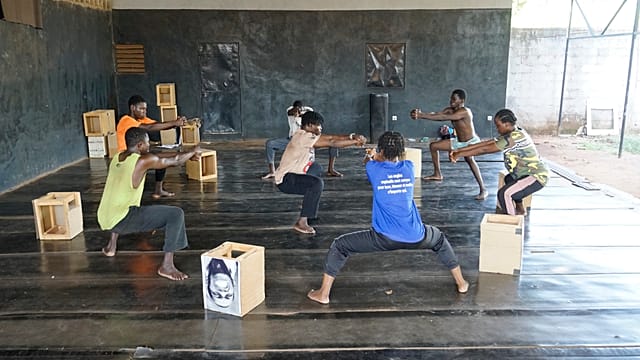
Adama Sanou is ready for another dance session with colleagues at Au Déla de l’Handicap (ADH) headquarters in Bobo-Dioulasso.
He's deaf, but that doesn't stop him taking part in an activity that relies on music.
These hearing impaired dancers use the Vibra-Signe technique to feel the rhythm.
Dance in the West African nation has become a tool for empowerment.
It's especially important here, where limited government support and resources have made it challenging for deaf people to thrive and socialize.
Using French sign language dance group member Adama Sanou explains: "I really like dance, the repetition, the learning. Love (of dance) is what encourages me to keep dancing.”
His desire to dance overcame his parents objections.
“When (my father) refused to let me dance, I left him alone, and I continued to dance because I love it. Naturally with time, he let me continue,” says Sanou.
Instructor Yaya Sanou developed the technique and runs the dance group.
He translates the beat with his face and gestures for the small group gathered around him.
The group of deaf and hard-of-hearing dancers feel and follow the rhythm and music through vibrations in the floor and Sanou's body gestures.
That makes it possible to follow music even without hearing it.
Yaya Sanou started out with his dance career in the streets of Sarfalao neighborhood in Bobo-Dioulasso many years ago, blending the traditional dances he learned at home with modern styles.
That was when he noticed that the children at the Institut des Jeunes Sourds du Faso, a local school for deaf children and others with disabilities, rarely socialize.
"I saw these children, these young people, they were always among themselves, they did nothing, they did not participate in socio-cultural activities. And me, that thing that caught my attention, I said to myself, it's not normal, we have to do something. And I decided to go and propose teaching dance and it all started there. And when I started, the impact, the reaction, the positive change in the daily life of these dancers, of these young people, made me understand that there was a need and there was no one else to propose something," he says.
The technique has gained popularity in and outside Burkina Faso with its use by members of the Fientan dance organization.
With Vibra-Signe, Fientan won a gold medal for dance creation at the 2023 Francophone Games that featured dozens of countries in Congo’s capital of Kinshasa.
Its latest production, “Adepte de mon être”, which in English means “Devoted to my being”, has also been performed by the group in Germany and Ivory Coast.
The dancing has improved the dancers' social skills.
Even the group’s name is empowering, they say, as Fientan means “without disability” in the local Dioula language.
Their teacher says it takes time to master the technique, to follow the rhythm, vibrations and body movements, but the result has been fulfilling for him and his students.
The dance itself provokes the questions which he wants society to answer.
He says: “What is their relationship, what is their place in this society? What is society's attitude towards these people? These are the questions we ask in this show. And also, how do you assert yourself? Through this show, how can they affirm and regain the place they want to have in this society?"
There’s no available recent data on the number of deaf and hard-of-hearing people in Burkina Faso, but the 2019 census recorded about 46,500 people aged 2 or older who had significant difficulty hearing or could not hear at all.
The country of around 24 million people has adopted inclusive-education programs and measures intended to improve access to the welfare and overall living conditions for people with disabilities including deaf and hard-of-hearing people.
But rights advocates and experts say implementation remains limited, with shortages of trained teachers and sign-language interpreters and inadequate access to support services.
A Burkina Faso study published by the country's Institute of Social Sciences (INSS) notes that 58% of its respondents have a “negative” perception of deafness because it is considered a “curse” or a “spiritual punishment.”