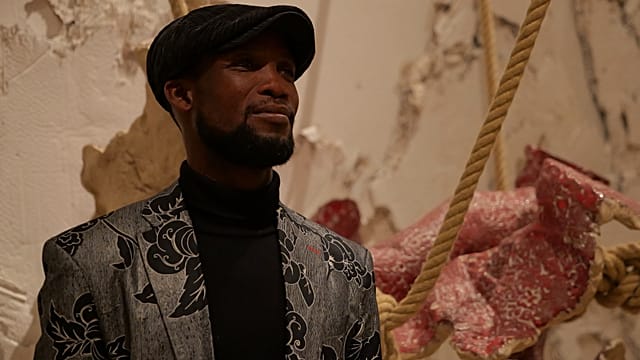
The Biennale of Contemporary Art in the French city of Lyon is one of the most important international events for the art scene. Part of this year's edition is "Ontology of projected movement", a singular project by the Togolese artist Kokou Ferdinand Makouvia.
The room at the Musée des Tissus et de l'Art décoratif in the French city of Lyon is quiet, its metres-high ceiling and dimmed lighting making it almost cathedral-like. Visitors on their itinerary through the museum slow down as they step into it, their eyes wandering from the monumental works covering both its side walls to the sculptures sitting on the ground or hanging from the ceiling.
The installation is called "Ontology of projected movement". Behind it is Kokou Ferdinand Makouvia, a Togolese-born artist and sculptor, who today mainly works in France.
To him, art is first and foremost a dialogue with the material he uses - be it copper, cardboard or clay - that leads to it taking its final form. But the dialogue continues even after the creation is finished:
"I talk to it, I ask it 'What is your name? What do you want to be called? How do you want to be perceived?'" he says.
Having arrived in France after having studied fine arts in Abidjan in Ivory Coast - there were no opportunities for a formal artistic education in his home country - Kokou Ferdinand Makouvia continued his education in the Beaux-Arts Valenciennes and Paris programmes.
In Paris, his works, oscillating between sculptures and installations, are exhibited at the Galerie Sator, in the heart of the French capital.
But his creations also travel frequently or come into being specifically for international events: from an artistic residency in Amsterdam to the Biennale in Dakar and Kinshasa in 2022, Kokou Ferdinand Makouvia continues to weave links between the African and the European continent.
It's also one of the elements that nourishes his work, together with reflections oscillating between the past, the present and the future.
But what remains above all is the notion of deep respect that arises from his way of working.
"Art remains a conversation between living beings, those who have left our world, the material - everything", he says.