EU and USA: A Glimmer of Hope on the Roller Coaster
Tariffs up, tariffs down — US President Trump continues to operate according to this principle, most recently applying it to Canada. And the EU? It concluded an agreement with the USA in 2025. One year on, it is time to take stock.
Donald Trump remains true to form: he is unpredictable. After the EU Commission announced a fine of 890 million euros against US tech giant Google on Thursday, tensions ran high within the authority. Yet the new tariffs announced by the US President the following day drew predominantly positive reactions in Brussels: everything in line with the Turnberry Deal, the trade agreement between the EU and the USA.
Just one day later, however, Trump lets his anger loose once again. Another "great" American company had been "illegally" penalised, he said. The USA was not Europe's piggy bank. And then he threatens "substantial tariffs." Unpredictable, as ever.
Ongoing Uncertainty
Trump's trade policy continues to generate uncertainty. For companies in Germany and the EU, this means anything but the planning security they need during economically strained times. On the positive side: things have quietened down. A major escalation — let alone a full-blown trade war — has so far been avoided.
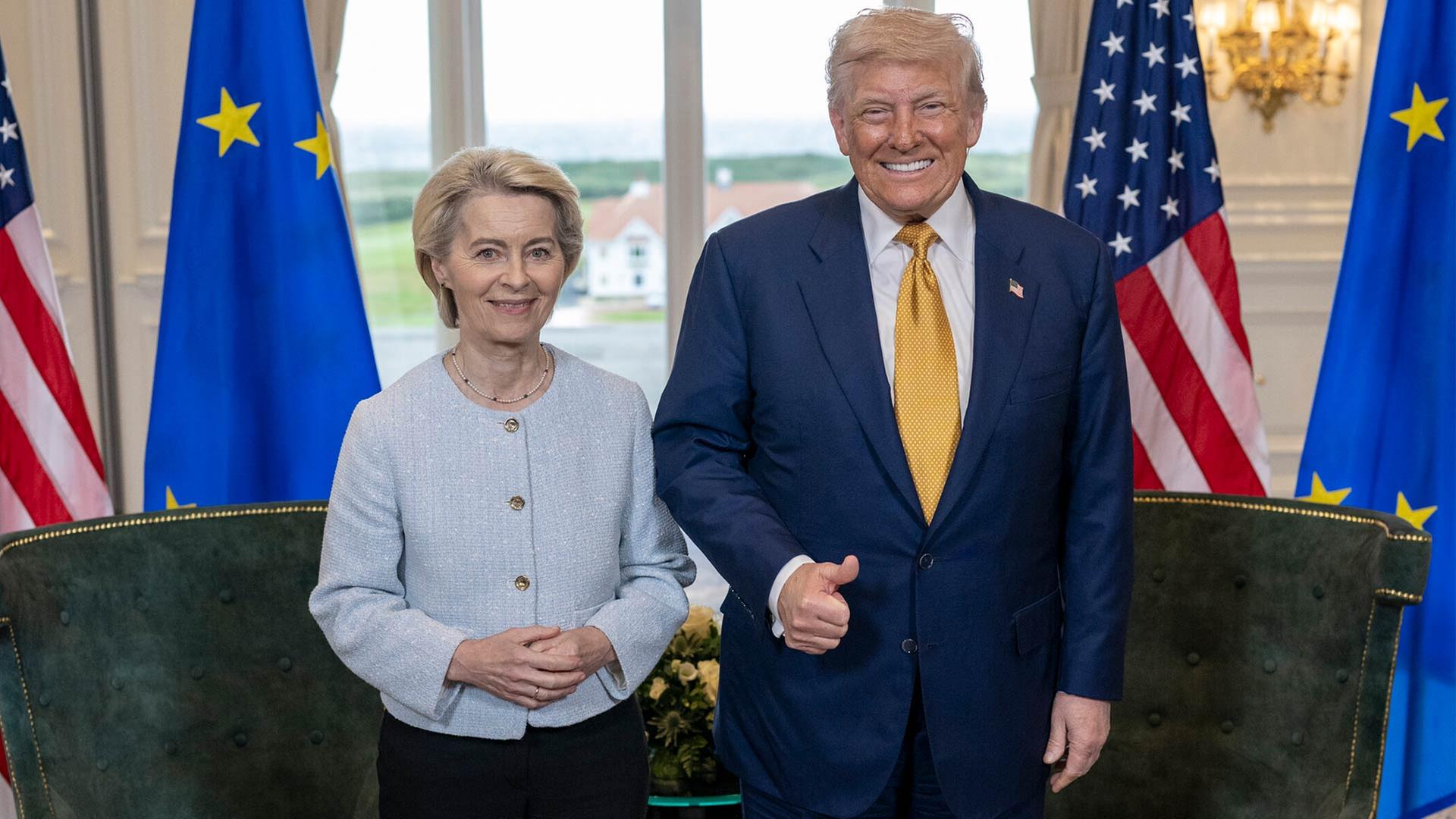
A key milestone was the agreement reached at Trump's golf hotel in Turnberry, Scotland, exactly one year ago. While hotel guests wandered to the sauna in bathrobes and slippers, the US President and Ursula von der Leyen, President of the EU Commission, were negotiating how to resolve a months-long tariff dispute.
What does the balance sheet look like twelve months later? In Scotland, the EU concluded an unequal agreement. The USA committed to imposing a maximum tariff of 15 percent on most imports from the EU. In return, however, the EU is scrapping tariffs entirely on most US industrial products.
In addition, the Commission held out the prospect of investments worth hundreds of billions of euros to Trump. While the authority could not actually guarantee this, Trump appeared to be convinced by the promise nonetheless. What has happened since?
Hope for Rising Exports
In a survey by the ifo Institute, more than 60 percent of German industrial companies reported having been negatively affected by US tariff policy. In the German automotive industry, the figure is almost three quarters.
Volker Treier, head of foreign trade at the Association of German Chambers of Commerce and Industry, has observed how companies have been deferring investments. Speaking to the ARD studio in Brussels about the current situation, he said: "With the Turnberry Deal, there is now a very tangible hope that exports to our still most important export market will rise again."
Alongside hope, there is above all scepticism on the EU side: "The risk that the deal could still be called into question remains," says Bernd Lange of the SPD, chair of the Trade Committee in the European Parliament. "That is why we will also make it clearly known which direction things need to go."
Steel Tariffs Remain High
There are still a number of unresolved issues. According to the EU Commission, 93 percent of EU exports to the USA are subject to a tariff rate of up to 15 percent. For steel, aluminium and certain products derived from them, the USA continues to apply significantly higher tariff rates. The EU has given the USA until the end of the year to change this.
The fact remains: the high tariffs are damaging the already weakened European steel industry every day. Because Trump has effectively shielded the US steel sector with his tariffs, ever-increasing volumes of cheap steel from Asia are flooding into Europe. Most recently, the European Union decided to impose stricter tariff rules on imported steel — an attempt to protect steel companies.
Strengthening Other Relationships
Ever since Trump held up his colorful chart of tariff rates in front of the cameras in April of last year, the European Union has not focused solely on appeasing the man in the White House. Instead, a whole series of trade agreements have been concluded: with Indonesia, India, Mexico, and not least the Mercosur agreement.
But even as other trade relationships gain in importance, the United States remains the most important trading partner for the European Union. Last year, the US and the EU exchanged goods and services worth around 1.8 trillion euros — more than in 2024 and equivalent to approximately 30 percent of global trade.
Billions in Promised Commitments
Likely also because of this significance, the EU has promised the US substantial sums as part of the Turnberry Deal: it intends to purchase energy in the US worth the equivalent of around 700 billion euros and invest a further roughly 520 billion euros. The European Commission is optimistic that this will indeed come to pass.
One year of the Turnberry Deal. For Bernd Lange, who negotiated on behalf of the Parliament, it was "quite a rollercoaster ride." And that ride is far from over, as Trump's threats following the EU's penalty against Google demonstrate. In the end, the US president remains above all one thing: unpredictable.