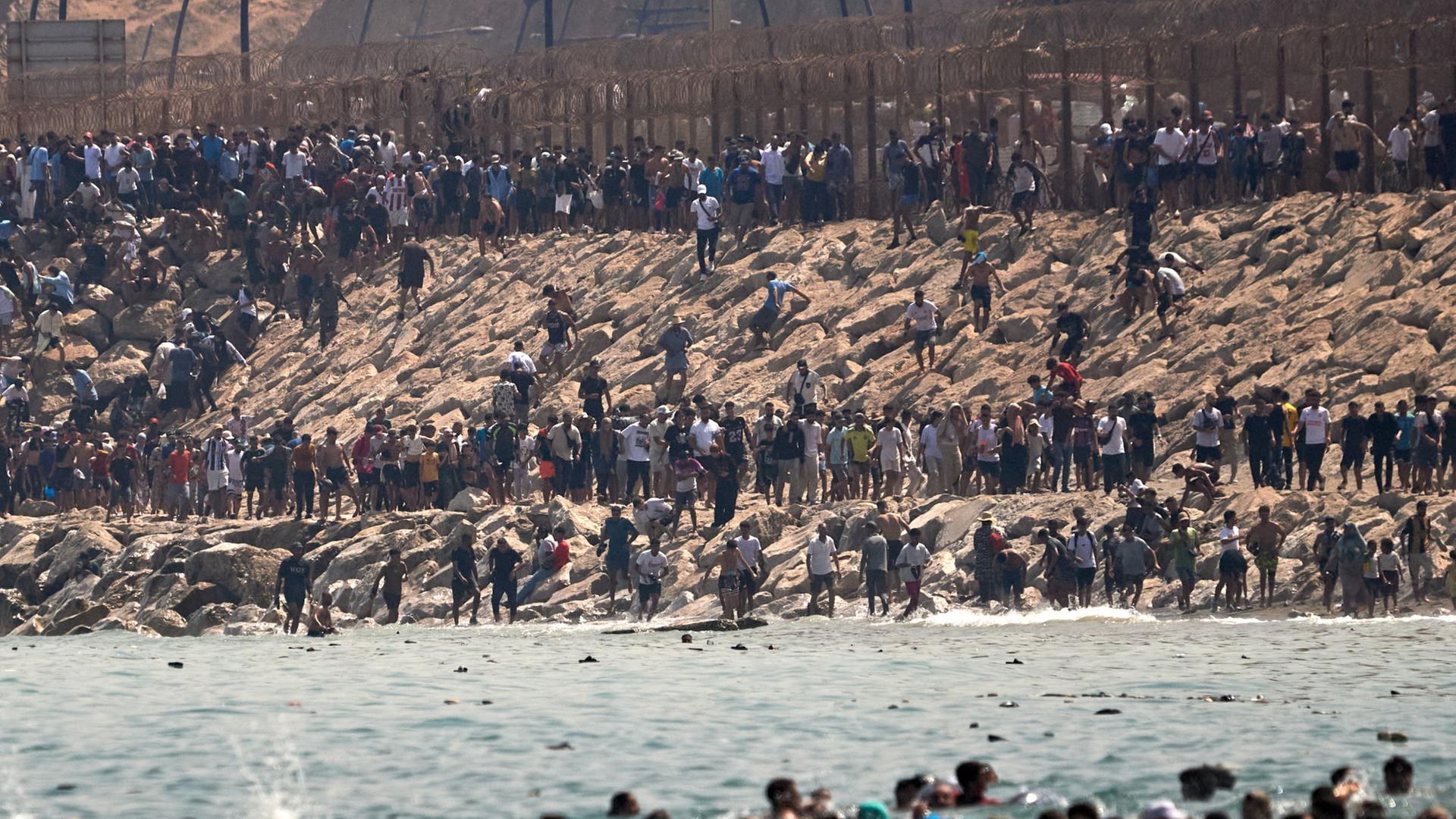
Arrival of Numerous Migrants: Spain Deploys Soldiers to Enclave of Ceuta
Within just a few days, thousands of migrants are believed to have entered the Spanish North African enclave of Ceuta — on Thursday, border security apparently partially collapsed. A court ruling may be behind the development. Madrid is now sending in soldiers.
After thousands of migrants swam their way into the Spanish North African enclave of Ceuta, the government in Madrid is deploying soldiers to the city. By Friday, three units of 20 soldiers each, a diving unit and a military vessel are to be transferred, the Interior Ministry announced. In addition, police special forces are to be reinforced to 200 officers. The soldiers are to support the Guardia Civil in "maintaining security in the city of Ceuta," the government stated.
In recent days alone, more than 1,500 migrants had already arrived, according to authorities. As a Spanish city on the North African coast, Ceuta is EU territory and borders Morocco. On Thursday, numerous migrants again reached the location. How many migrants arrived in total over the course of the day remains unclear — media estimates range from "hundreds" to "several thousand."
At Least Nine People Killed
Reception centers are overwhelmed many times over, with many people currently living and sleeping outdoors. Spanish authorities also reported at least nine people who lost their lives while attempting to reach Ceuta.
Regional President Juan Jesús Vivas had called on the central government in Madrid to declare a state of emergency for "reasons of national security." He also requested the deployment of additional police forces and the army to the border between Morocco and Ceuta. However, Madrid rejected the declaration of a national state of emergency.
Court Ruling on Migration
One possible explanation for the development is a ruling by Spain's Supreme Court from early July. Anyone intercepted at sea while attempting to reach Ceuta by swimming may not be immediately returned to Morocco. Instead, a regular immigration procedure is required. Spain's Interior Ministry accuses smuggling networks of exploiting the ruling.
At the same time, videos of successful border crossings and calls for further attempts are spreading on social networks. According to a local reporter speaking to the news agency EFE, such attempts are being prepared and coordinated in closed messenger groups. What remains unexplained, however, is why the security of the land border also temporarily collapsed on Thursday.
Prime Minister Sánchez Travels to Ceuta
Ceuta last experienced a comparable situation in 2021, when more than 8,000 people arrived within two days — during a severe political crisis between Spain and Morocco. There are no indications of such a conflict this time around. Nevertheless, concern about further escalation is growing in Ceuta. All factions in the city parliament are now jointly calling for tougher intervention: "State security forces should be reinforced and the military deployed to protect the border and public safety," they stated.
Prime Minister Pedro Sánchez and Interior Minister Fernando Grande-Marlaska announced they will travel to Ceuta on Friday to assess the situation on the ground. Spain and Morocco intend to strengthen border controls and accelerate deportations. Morocco is thereby signaling its willingness to cooperate. What remains unclear is how quickly the situation can be stabilized and how the large number of people will be cared for in the meantime.
With reporting from Luca Kissel, ARD North Africa bureau