Premier Carney in EU Parliament: Canada Open to Special EU Membership
Not a full EU member, but a kind of special membership – that could be what Canada receives. The EU has made such a proposal, and Premier Carney has welcomed the initiative. Whether it will actually come to fruition, however, remains uncertain.
US President Donald Trump's aggressive trade and foreign policy has severely strained what had been the close relationship between the United States and Canada. The North American country is therefore searching for new, reliable partners – and may find them in Europe. A significantly closer cooperation between the European Union and Canada appears to be taking shape.
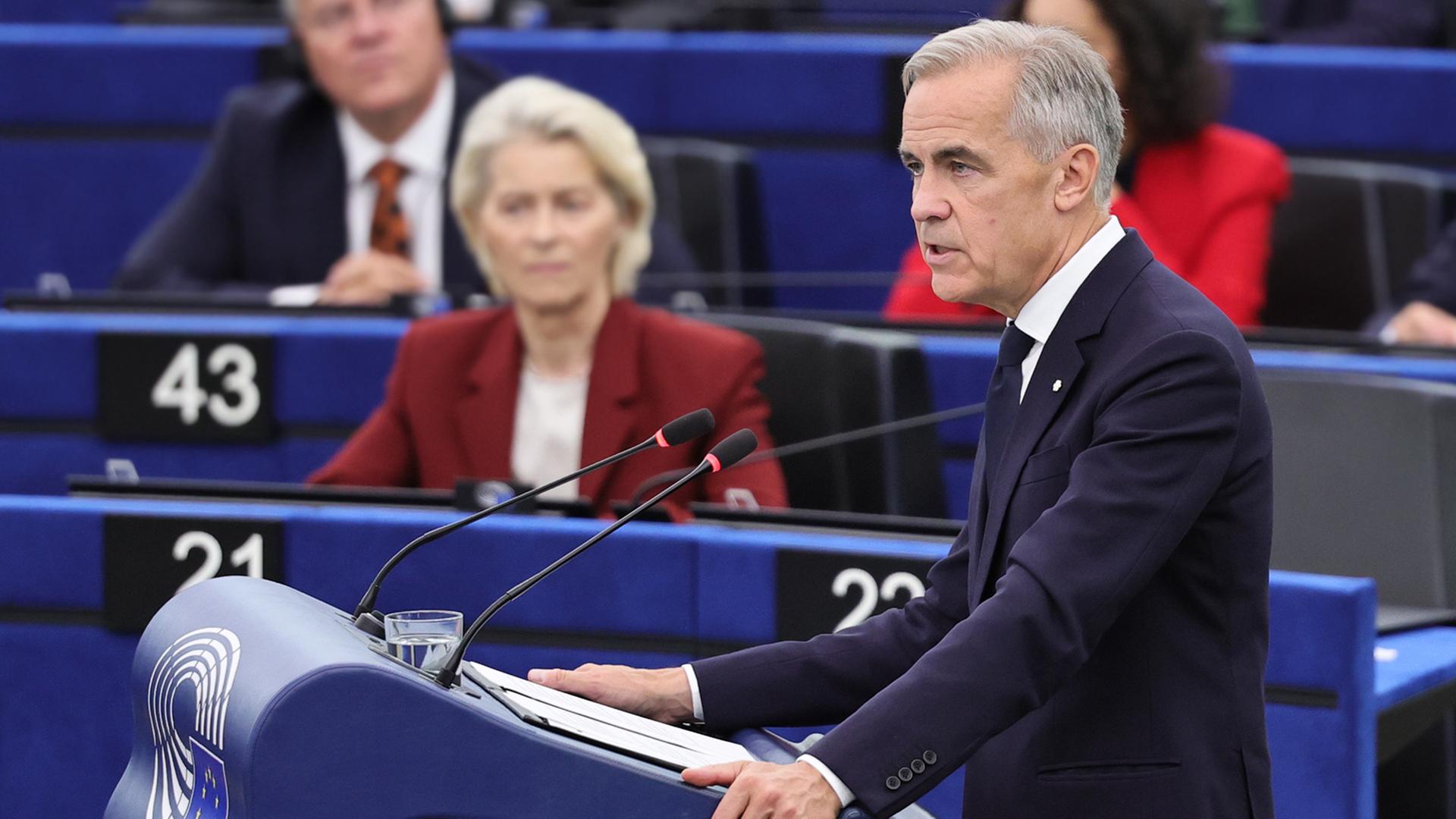
This became clear today during Canadian Prime Minister Mark Carney's appearance before the EU Parliament. In a speech to the parliamentarians, Carney made clear that his country is open to the idea of a kind of special EU membership. "We welcome this initiative," he said. Polls showed that an overwhelming majority of Canadians would support significantly closer ties, Carney added.
"Together We Are Stronger"
"We are not fair-weather allies," the Canadian told the members of parliament. "We stand for shared values that we have always fought for." Canada and the EU are each strong, Carney continued, "together we are stronger."
EU Commission President Ursula von der Leyen had on Wednesday advocated making Canada the first "associate member" of the European Union. As concrete areas for even closer cooperation, von der Leyen named technology issues, the production of defense goods, as well as artificial intelligence and Arctic policy. However, she did not initially explain how an associate EU membership would be structured in concrete terms.
No Rivalry with Major Powers
Carney said Canada and Europe should secure their strategic autonomy through close cooperation across the entire spectrum of strategic capabilities. "We want to become more resilient so that no one can control our open markets, undermine our sovereignty, threaten our territorial integrity, or subvert our freedoms, our democracies, and our rule of law," he stated.
Carney emphasized that the goal is not to create a third bloc that would become a rival to the major powers. They are not seeking power to dominate others.
Trump Warns, Brussels Appeases
US President Trump had previously responded to von der Leyen's proposal with a threat. "I think that's ridiculous," he said when asked about the proposal. Should he consider it a "hostile act," he would impose high tariffs or halt trade with Europe in many areas, Trump warned.
A spokesperson for the EU Commission then stated: "As our President made clear yesterday, the proposed strengthening of our partnership with Canada is directed against no one. Rather, it is intended to promote our shared strength."
Free Trade Agreement Not Yet in Force
Regular EU membership for Canada is not possible under the current treaties. According to Article 49 of the EU Treaty, only European states may join the Union.
Canada is currently closely linked to the EU primarily through the CETA free trade agreement. This has been provisionally applied since 2017, but has still not formally entered into force. Ten member states, including Belgium, France and Ireland, have not ratified it to this day. This is also one of the reasons why it is considered highly uncertain whether the idea of an associated EU membership for Canada can be implemented.