SPD Before the Elections: Pinning Hopes on Schwesig
The SPD is hoping that Minister-President Schwesig will prove a draw for voters in the Mecklenburg-Vorpommern election. A success could stabilise the party somewhat, but the mood remains tense.
One thing is clear for the federal SPD: the party urgently needs a genuine success. Since SPD politician Steffen Krach is unlikely to win the post of Governing Mayor in Berlin, much depends for the SPD on incumbent Minister-President Manuela Schwesig in Mecklenburg-Vorpommern.
She is currently closing in on the AfD, so Sunday could, for the first time in a long while, give the Social Democrats something to celebrate. The mood is nevertheless grim, and there are many reasons for that.
Race in Mecklenburg-Vorpommern Appears Open
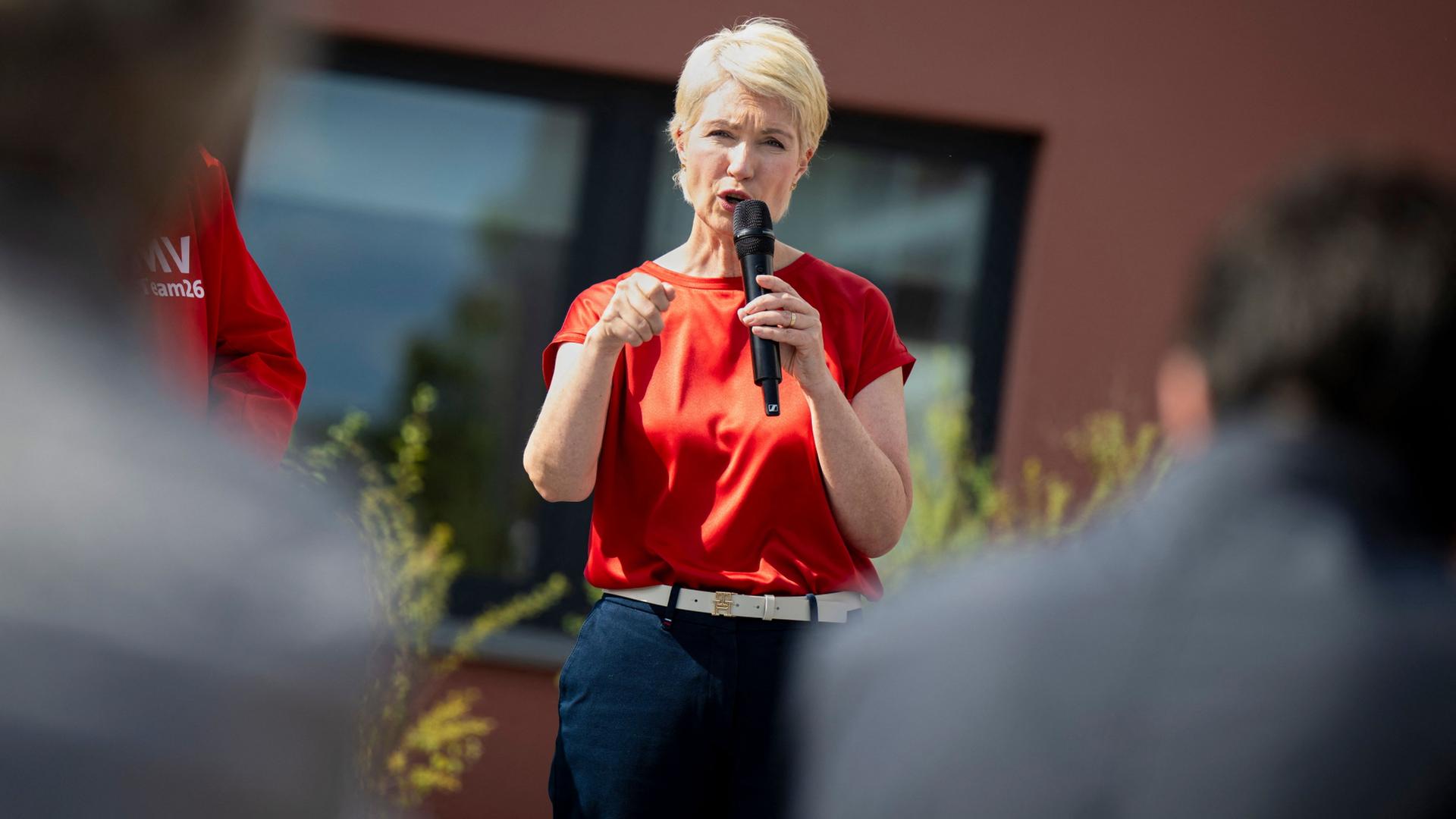
The Minister-President of Mecklenburg-Vorpommern is running an election campaign the likes of which the SPD has not seen for a long time. She is positioning herself as the "woman against blue" — her slogan — and aims to overtake the AfD. Although polls currently still show the AfD narrowly ahead of the SPD, the race appears open. "Anyone who wants me to stay must go to the polls and vote SPD," Schwesig says with confidence. She is the SPD's driving force.
She does many things better than other senior SPD figures. Her social media presence, for example: there she appears in a hoodie at a barbecue or sitting on a park bench with elderly women. And this is no mere performance. Schwesig is touring villages throughout the campaign. "I believe the SPD would be well advised to be present locally, to know the everyday issues, and people need to feel that their daily lives are improving."
On the campaign trail, Schwesig distances herself from reform proposals coming out of Berlin — for instance, the proposal to abolish the penalty-free pension after 45 years of contributions: "I know the situation of the people here and I know that many have worked and contributed for 45 years and even longer, yet still receive only small pensions. That is why I do not think it is right when proposals like these come along to cut pensions."
Krach Trailing in Polls
His colleague Steffen Krach, the SPD's lead candidate in Berlin, takes a similarly critical view of pension reform. Krach is also standing for election on Sunday, seeking to become Governing Mayor: "I speak out quite plainly when I believe things are going wrong. For example, when the federal level says it wants to cut housing benefit by 1.5 billion euros, I consider that to be wrong."
But Krach cannot keep up with his party colleague Schwesig and is trailing far behind in the polls. He is also burdened by investigations into corruption allegations. This leaves his clear distancing from the federal government's reform agenda as the only thing he has in common with Schwesig.
Dissatisfaction with Federal Politics Is High
This is an obvious strategy, says political scientist Uwe Jun — particularly for Schwesig — because dissatisfaction with federal politics is high in the eastern German states: "We saw that in Saxony-Anhalt too. But there was no sufficiently popular leading figure there who could compensate for it. Individual minister-presidents can succeed in compensating for this dissatisfaction and making an election strongly personalised. If they manage that, they can decouple themselves from the federal party."
Krach and Schwesig are articulating what they repeatedly hear from voters on the campaign trail. People are reflecting their dissatisfaction back at them.
The SPD's Dilemma
For the SPD at the federal level, this is a problem, because in the coalition with the CDU and CSU the party must make painful compromises for itself and for voters. So far, the party leadership has found no solution to this dilemma. On the contrary: following the state election in Saxony-Anhalt, the party has come under even greater pressure. It therefore looked like a flight forward when the SPD leadership immediately announced its intention to revisit the reform course agreed upon with the Union: "No social reforms against the people," said Labour Minister Bärbel Bas.
Moreover, the SPD must contend with its coalition partner CDU/CSU, weakened by the Saxony-Anhalt result, and withstand its attacks. Christian von Stetten, head of the parliamentary group for small and medium-sized businesses, called for Bärbel Bas to resign. Within the SPD, however, this has rather led to greater backing for the Labour Minister.
Furthermore, the debate over fuel prices has once again brought the economic and fiscal policy differences between the SPD and CDU/CSU into sharp relief. Both sides keep exchanging the same arguments but cannot find common ground. What remains is the determination to demonstrate the ability to act before the state elections on Sunday.
"Nobody wants to board a sinking ship"
There are also internal personnel discussions within the SPD that could gather momentum after the elections in Berlin and Mecklenburg-Vorpommern. Political scientist Wolfgang Schröder, himself an SPD member, says there has long been grumbling within the SPD over the dual roles of the two party co-chairs Bärbel Bas and Lars Klingbeil, both of whom simultaneously lead ministries. Schröder, however, sees no alternatives "pushing to the fore." With an eye on the beleaguered coalition partner CDU/CSU, the SPD will initially play for time and keep a low profile.
The political scientist identifies leadership personnel problems in both camps: "They are greater than ever before in the history of the Federal Republic. We have a genuine elite problem at the level of party leadership. And this at the most difficult juncture in the Federal Republic's development. Party chairs with whom not only the public is dissatisfied, but their own people too. And at the same time, nobody who is genuinely seeking that office and who is trusted to fill it better than those who currently hold it. Nobody wants to board a sinking ship. But the Union must act, because the problem is greatest for them."
If the SPD wins the election in Mecklenburg-Vorpommern, that should stabilise the two co-chairs Klingbeil and Bas for the time being. No major upheaval is to be expected on Monday.