United Nations: How the Debate Over Guterres' Successor Unfolded
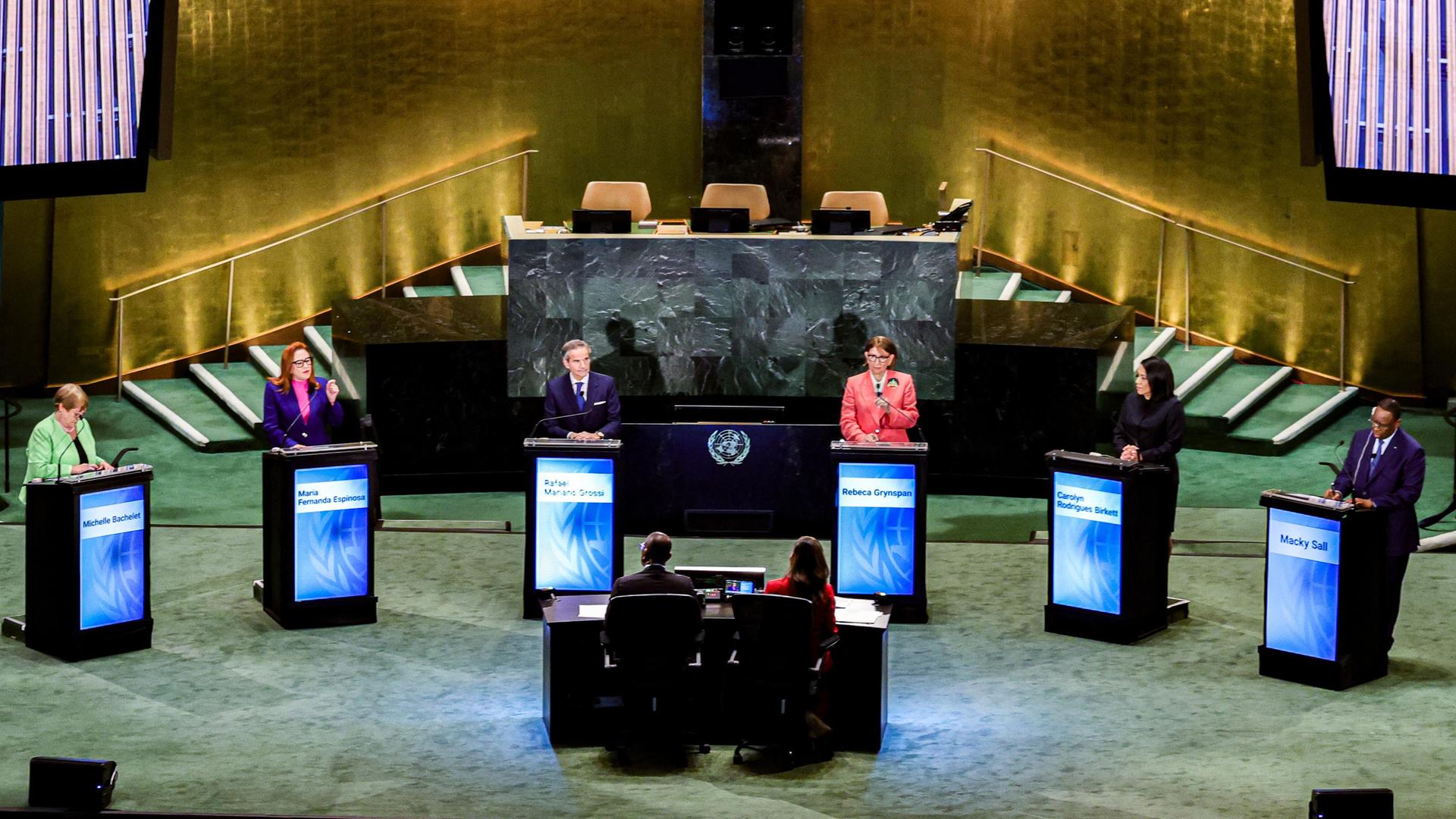
Who will succeed UN Secretary-General Guterres? Six candidates presented themselves in a public debate. What united them: the desire for a strong United Nations.
The debate's biggest loser was not even present in the General Assembly hall. The outgoing UN Secretary-General António Guterres was not mentioned by name, yet all candidates for his succession arrived at a similarly sobering verdict: the United Nations is currently on the sidelines.
Rafael Grossi, the Argentine director of the International Atomic Energy Agency (IAEA), put it plainly:
"The United Nations is not involved in resolving the most serious conflicts we are witnessing."
Guterres would likely have countered that this is not his fault, but rather that of the veto powers on the UN Security Council, which frequently block one another on the most important wars and conflicts.
Grossi was unwilling to accept the notion that a Secretary-General is often more "Secretary" than "General." The 65-year-old said that in his current role as IAEA chief, he had repeatedly succeeded in bringing Russia and Ukraine together: "We have so far brokered six ceasefires to carry out essential repairs at the Zaporizhzhia nuclear power plant, preventing a major accident."
Grynspan Wants a UN That "Has a Seat at the Table Again"
Among the four female candidates, Rebeca Grynspan made the strongest impression. The former Vice President of Costa Rica is an economic expert and Secretary-General of the UN Conference on Trade and Development (UNCTAD). She too emphasized that she had successfully mediated between Russia and Ukraine.
Four years ago, she brokered the grain agreement that prevented a global hunger crisis. As UN Secretary-General, she said she would advocate for peace through mutual trade and against tariffs and protectionism. After her first five-year term, no one should be asking: "Where is the UN?" Instead, she envisions a UN that "has a seat at the table again."
The questions from the two moderators and the UN ambassadors present in the hall ranged widely: What is to be done when a veto power blocks action? What should be tackled in the first 100 days? How can the UN be reformed and made more efficient?
Chile's Former President Has Little Chance
The most prominent candidate gave a rather pale and overly labored performance: Michelle Bachelet, the former President of Chile. Her candidacy is already considered a long shot, as her advocacy for women's rights has drawn the displeasure of the Trump administration. Former Ecuadorian Foreign Minister María Fernanda Espinosa and former Senegalese President Macky Sall also failed to convince.
Among the UN staff present in the hall, the youngest candidate received the warmest reception: the 52-year-old UN Ambassador from Guyana, Carolyn Rodrigues-Birkett.
Ultimately, however, the deciding factor lies with the 15 member states of the UN Security Council. At least nine votes in favor are required there. And more importantly, none of the five veto powers may vote against. It remains quite possible that in the end, the United States, China, and Russia will once again settle the question of Guterres' successor among themselves.
It is equally possible that the wish of Annalena Baerbock, President of the UN General Assembly, to see the first woman at the helm of the United Nations will once again go unfulfilled.