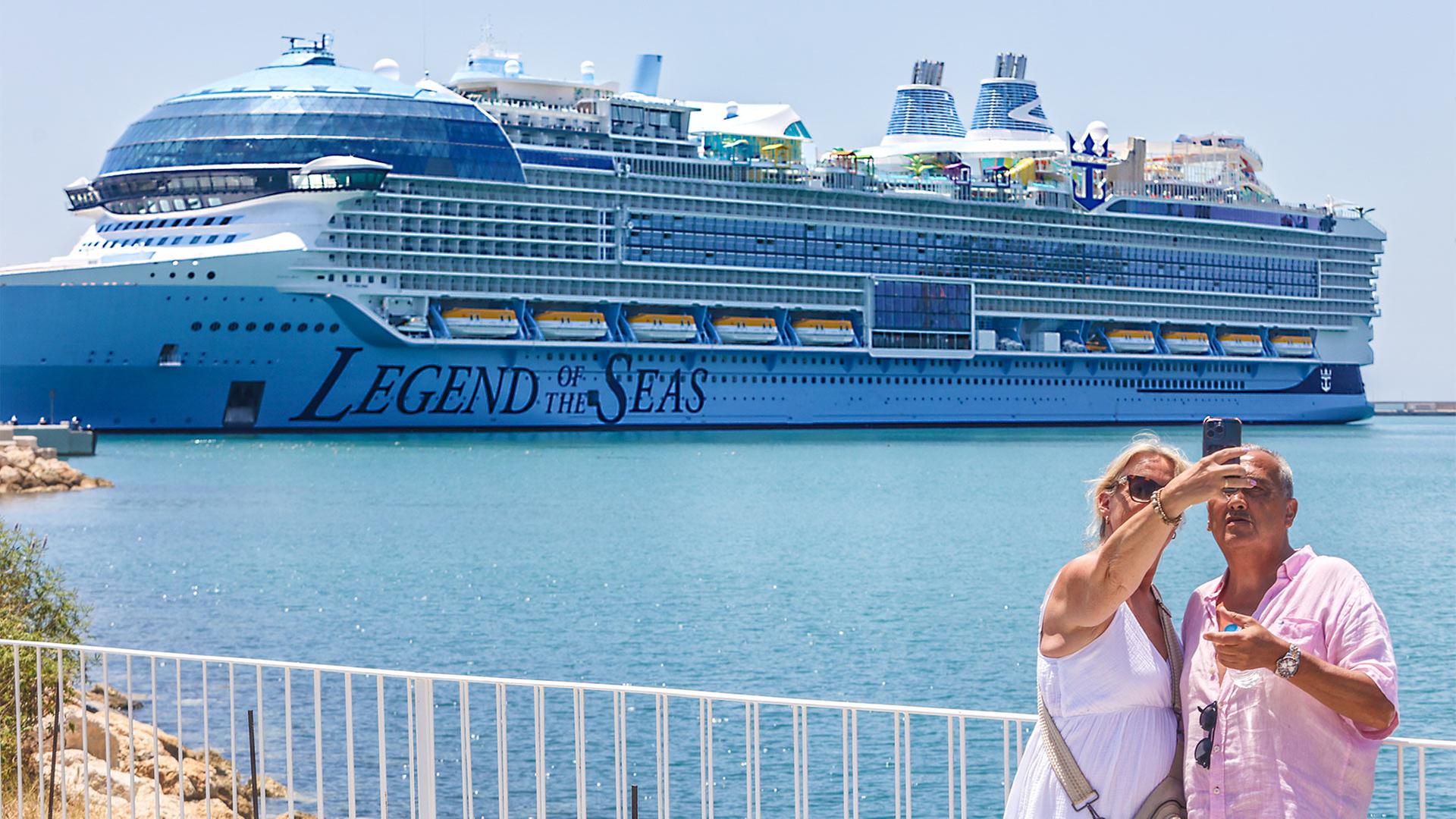
Travel Trends: Cruises Are Booming – Despite Crises
A gloomier economic outlook, higher energy costs and global instability are doing little to slow the cruise industry. Industry associations are forecasting record passenger numbers. But risks remain.
More than 37 million ocean cruises took place worldwide last year – more than ever before. That is the finding of the Cruise Lines International Association.
The association represents more than 95 percent of global cruise offerings and expects further passenger records in the coming years: more than 38 million cruises could be sold in the current year, and over 42 million by 2029.
Holidays Are a Must for Many
One reason is that Germans, who are among the most avid cruisers, apparently tend to cut back on other expenses before sacrificing their holidays – even as the economic outlook worsens.
Christian Röhl, Chief Economist at the neobroker Scalable Capital, explains: "In recent years we have seen a certain shift in consumer behaviour. When people save money, they tend to cut back on classic material consumption – furniture, cars, clothing – and instead treat themselves to experiences. And one beautiful experience is, of course, a holiday."
The Hotel Comes Along
The fact that cruises in particular are winning over more holidaymakers has a lot to do with their concept, Röhl observes: "It's a complete all-inclusive package. Once you've made the decision to go on a ship, you can spend your entire holiday there and have a great deal organised for you."
It is about convenience: food is taken care of, as is entertainment, wellness and sports facilities. You can book extras, such as shore excursions, but you don't have to. And no matter where you go ashore, the floating hotel is always there with you.
In cruise travel, there is now almost nothing that doesn't exist: from budget to extreme luxury, from small ships to giant liners carrying more than 7,500 passengers. There are cruises for families, for singles, for schlager or heavy metal fans, ranging from party-focused to cultural.
Americans Are the World Champions of Cruising
This seems to convince many people – especially in the United States, which is home to the most enthusiastic cruisers. Last year, the international industry association CLIA recorded 20.6 million ocean voyages originating from the US – an increase of 7.5 percent compared to the previous year.
German cruisers follow in second place – by a wide margin, but second nonetheless. Nearly three million ocean cruises were taken in 2025, ten percent more than the previous year.
A Lucrative Business Model
For shipping companies, the business appears to be paying off. Royal Caribbean Group, one of the world's leading cruise companies, posted a net profit of over four billion dollars last year.
The ticket price for cruises is structured to cover fixed costs as far as possible, says Röhl of Scalable Capital. Tickets can be offered at comparatively affordable prices – especially when thousands of passengers are on board – which helps fill the ships: "The profit actually comes from the extras: shore excursions, speciality restaurants, spa offerings, the casino and drinks packages." Because all of that comes at an additional cost.
One advantage of ships compared to most onshore locations: on board, the shipping company is a monopolist, Röhl emphasizes. "That means, no matter where you spend money — and even if you go shopping on board purely out of boredom or buy art — it always ends up in the shipping company's pockets in the end. It's quite a nice business model."
Cruise stocks: On a growth trajectory after COVID
A business that has also convinced many equity investors. The three largest shipping companies in this highly concentrated market are based in the USA: the largest cruise line by number of passengers and ships is Carnival Corporation, followed by the Royal Caribbean Group and Norwegian Cruise Line.
The names may be largely unfamiliar to customers in Germany. What few people know: AIDA Cruises, which operates in this country, belongs to Carnival. The Royal Caribbean Group operates, together with the TUI Group, the "Mein Schiff" brand, which is well known in the German market.
The three top cruise providers are listed on the New York Stock Exchange. All are part of the S&P 500, the index of the 500 most important companies in the USA.
Since the end of the COVID crisis, the companies' shares have been on a recovery course. Prior to that, the value of these at times very successful stocks had collapsed due to the pandemic. No wonder, given that there were barely any or at times no ship voyages at all, while fixed costs remained.
Iran war causes uncertainty
This also showed: the industry is highly dependent on external factors. Global crises such as the war waged by the USA and Israel against Iran are causing some investor uncertainty, analysts observe. Cruise stock prices reacted with volatility. But the positive trend is still holding, it is said.
Rising fuel prices resulting from the Iran war are indeed making their mark in the shipping companies' books, according to experts. As is the fact that voyages — to Dubai or the Persian Gulf, for instance — had to be cancelled due to the war.
However, larger impacts could be averted because alternative destinations were sought. Torsten Kirstges of Jade University of Applied Sciences in Wilhelmshaven says: "The shipping companies had to cancel many destinations in the Arab world. They had to reroute to other, safer travel destinations."
That creates work and therefore also costs money, but if everything goes well, revenue flows again through the newly chosen destinations. Tourism researcher Kirstges also emphasizes: "The destinations in the Arab world are not the cash cows of the shipping companies." Cruise customers' favorite destinations lie elsewhere: in the Caribbean, the Mediterranean, and the Baltic Sea.
An investment marathon lies ahead
But the cruise industry also has numerous other challenges to contend with. There are the mountains of debt that were partly accumulated during the COVID pandemic. At the same time, the business is very capital-intensive, Röhl explains: "The large ships of the latest generation cost 1.5 to two billion dollars. You have to have that first. And once it's been financed accordingly, we're immediately on the topic of interest rates."
There are also demands to improve the working conditions and wages of employees on the ships. The labor law of the country in which the respective ship is registered always applies. "These are mostly countries that don't have labor laws like we do in Germany."
Customers shy away from extra payments
On top of this come increasingly strict environmental regulations requiring heavy investment: for example, in ships powered by more environmentally friendly fuels such as liquefied natural gas or methanol. Tourism researcher Kirstges says: "To be fair, one has to acknowledge that the cruise industry is moving in the right direction on social and environmental issues — perhaps a little too slowly."
However: "Customers appreciate it when providers adhere to social standards or invest in environmental protection. They're happy to have it. But they're not willing to pay another hundred euros for a provider that operates more sustainably." This is likely to eat into the margins of shipping companies that place a particular emphasis on sustainability.