Berlin SPD Candidate Krach Prefers to Look Ahead
The Berlin SPD's lead candidate has a declared goal: he wants to win back the Red City Hall for the SPD. But the polls are not exactly encouraging for him. On top of that, there are investigations against him.
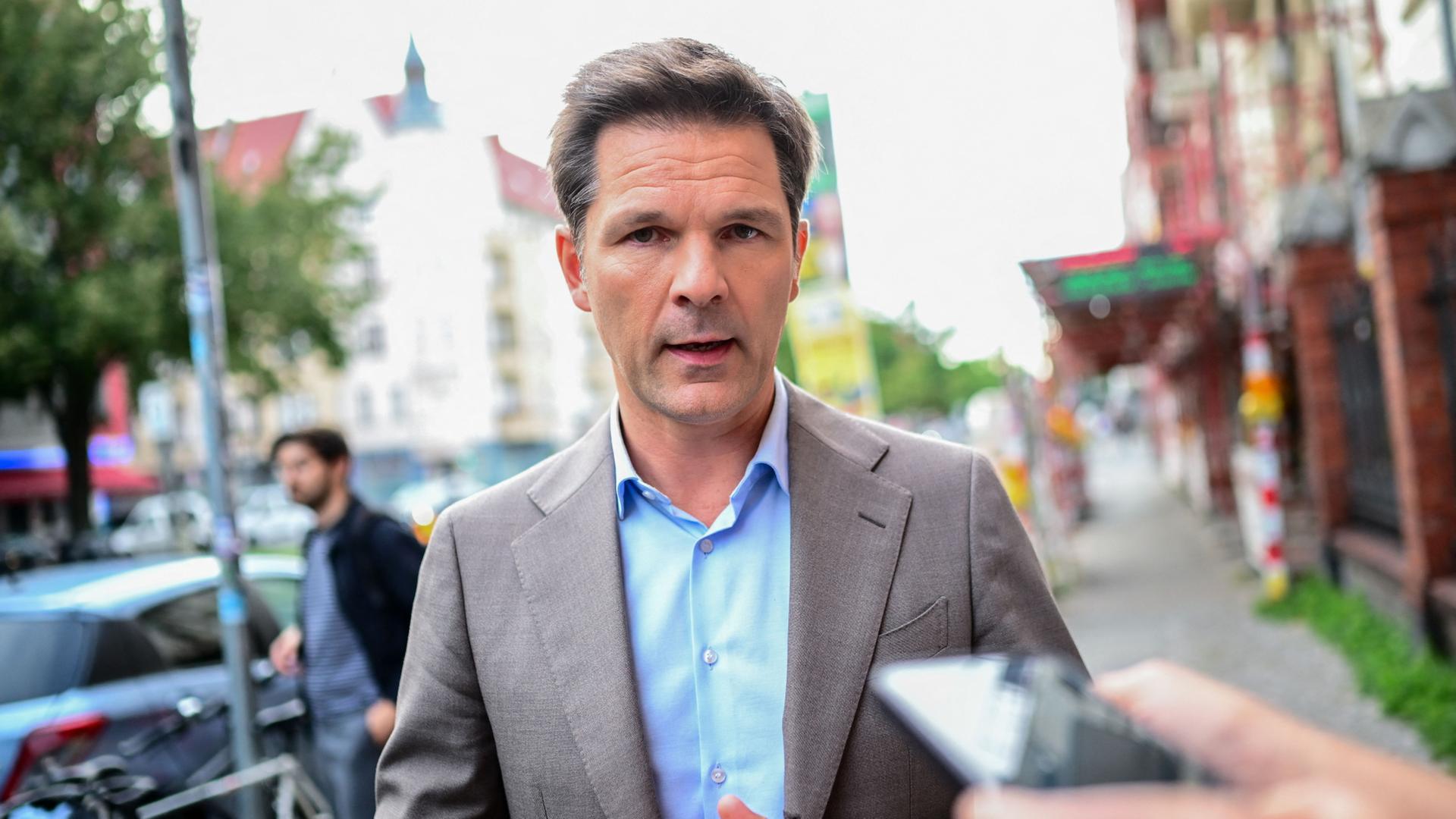
When SPD lead candidate Steffen Krach visits a Berlin school, one gets a sense of the dilemma facing the Social Democrats, who have spent the last three years co-governing the city as junior partners to the CDU.
Krach is visiting the Gretel Bergmann School in Berlin-Marzahn. The large community school has a student body for which headteacher Robert Hüttner claims special support needs. Between 20 and 30 percent have trouble showing up to class reliably at all — due to family conflicts or mental health problems. In the high-rise residential area on the city's outskirts, an above-average number of families receive social welfare benefits.
Only a third are qualified teachers
At the Gretel Bergmann School, Krach visits a 10th-grade class being taught today by Mr. Heide. Mr. Heide, wearing black horn-rimmed glasses and a white polo shirt, only recently sat his Abitur himself — he is 19 years old and a teaching student in his third semester. The school is trying to address the teacher shortage with nearly a dozen students. According to headteacher Hüttner, only two thirds of the school's teachers are qualified educators. He also wishes for significantly more social workers.
Schools and education policy is one of the few areas where Germany's federal states can largely determine their own direction. For the past three years, the CDU has held the position of Berlin's Senator for Education, but the SPD controlled the portfolio for 27 years before that. Krach, a trained political scientist, once served as chief of staff to the then-SPD Senator for Education, Sandra Scheeres.
"It won't happen overnight"
Berlin has for many years consistently ranked near the bottom in various comparative education studies. And not even SPD candidate Krach — visiting the school dressed in a light summer jacket and white sneakers — attempts to present Berlin's education policy as a success story. "I would definitely not stand here and say we got everything right over the last 20 or 25 years. I'm not saying that."
Krach does point out, however, that Berlin's so-called School Construction Offensive has in recent years enabled many schools to be fully renovated or newly opened. The SPD politician speaks of an ongoing process. "It won't happen overnight — that's partly frustrating. And the same applies not only to the buildings, but also to the supply of qualified teachers."
Experienced, pragmatic and fresh
Last November, Krach was unanimously elected as lead candidate by the Berlin SPD at a state party conference. The frequently fractious SPD state association wanted to put forward an untested face with Krach's selection. While Krach had gained experience between 2014 and 2021 as Berlin's State Secretary for Science, earning considerable recognition among insiders in the process, he was not at the forefront of his party at the time. In 2021, he returned to his birthplace of Hanover, where he became Regional President — a role similar to that of a district administrator for the greater Hanover area.
Experienced, pragmatic and fresh – that is how Krach is trying to win over voters. A typical line from him is that he wants to look not so much backward, but above all forward. He also argues that quite a lot has been achieved in Berlin: "In the area of science, in the cultural sector, we have 500,000 more jobs in the city than 30 years ago."
The SPD has plastered Krach's image across the city on a large scale – including one poster showing him with a determined gaze and the slogan: "The rent madness ends now." The housing shortage and rising rents are one of the central campaign issues in the capital. Krach is promising better protection for tenants through a verifiable rent register and accelerated new construction. He points out that 80,000 new apartments have been built over the past five years, including many social housing units.
The lead candidate does, however, concede that the self-imposed new-build targets of 20,000 apartments per year were not met. Since 2021, the SPD has provided Berlin's Senator for Construction. That, too, is a dilemma for Krach.
SPD at a polling low
When Krach was named lead candidate in autumn of last year, the Berlin SPD was polling at between 13 and 16 percent. In the ARD pre-election poll conducted by Infratest Dimap on 10 September 2026, the SPD stands at 12 percent, placing it fifth among the parties. The figures from the previous week (2 September 2026) also show that only 19 percent of Berliners are satisfied with the work of the CDU/SPD Senate, while 77 percent express dissatisfaction. A difficult starting position for Krach and the SPD as they seek to lead the future Senate.
In addition, lead candidate Krach has for the past several days been confronted with investigations by the Hannover public prosecutor's office relating to his former role as Regional President of Hannover. According to investigators, the proceedings concern, among other things, an initial suspicion of accepting benefits in two cases. Krach rejects all allegations. The presumption of innocence applies.
In any case, a governing majority without SPD participation is unlikely to materialise, since no party wishes to form a coalition with the AfD. According to the polls, the election could produce enough support for a coalition of CDU, Greens and SPD, as well as for an alliance of the Left, Greens and SPD. However, Krach has spoken out against the expropriation of housing corporations – something the Left Party has declared a condition for any coalition.
Since 1989, since Walter Momper's red-green Senate, the SPD has governed Berlin – either as the mayor's party or as junior partner. Steffen Krach and his Social Democrats have every prospect of that continuing, regardless of how well or how poorly the party performs on 20 September.