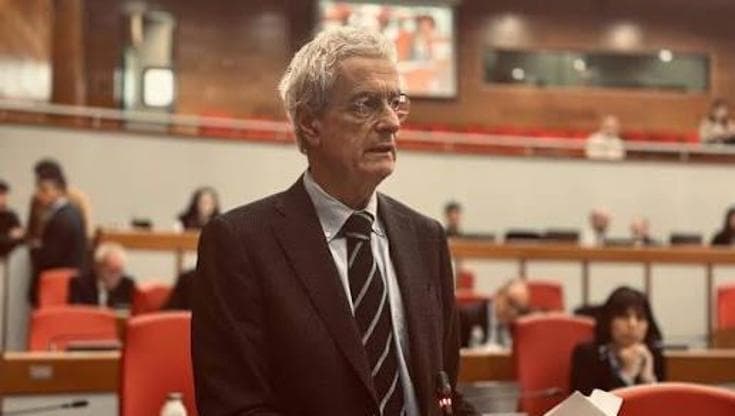
"Cura is a right, it can never be a crime." Giovanni Gordini, longtime director of the intensive care unit at the Ospedale Maggiore and now a civic regional councillor supporting president Michele de Pascale, says this first and foremost as a physician, with regard to the Ravenna Prosecutor's Office investigation.
What do you make of what is happening?
"The Medical Association has also said it: a doctor must think first and foremost about the patient's wellbeing and how to protect their health. Then it is also important to say something else: the protection of health cannot become a tool for governing public order. Healthcare workers cannot be used as instruments of confinement or control, to send second-class citizens — those with fewer rights — into immigration detention centres. And, I would add, there is another issue, that of vulnerability, which is also discussed in the new European Pact on Migration. The vulnerability of a human being is not something that can be assessed in ten minutes with a patient in handcuffs and police waiting in the hospital. We are talking about people who have a past — sometimes very recent — of family tragedies or violence, who are arriving from the detention camps in Libya. How can one do it? Vulnerability must be understood and reconstructed."
Searches at five in the morning as if they were mafia members, said lawyer Fabio Anselmo.
"The judiciary is right to conduct its investigations. Then there are the theatrical aspects. What I mean is: are we really sure that the doctor at Sant'Orsola was reachable at 5:30 in the morning but not at 8:00? All of this is part of a script that some people today are staging very deliberately."
Is this a climate that may have consequences for those who today find themselves filling out a fitness certificate? Is it a form of intimidation?
"The pressure being exerted on that world — which still today must continue to make those choices — is certainly very intense. We need to ask ourselves what kind of healthcare support we are providing to these migrants. There is a need to draw a clear distinction between how I protect their health and how they are judged if they have committed crimes. The diagnostic process must not be subjected to the timelines of a bureaucratic assessment. I make that assessment in good conscience and according to my professional knowledge, in hospitals, precisely because it can only be based on examinations and conversations when the situation is straightforward — but it almost never is. And we know that infectious disease specialists and psychiatrists are normally involved."
The Ravenna Prosecutor's Office maintains that behind all this lies a system, an organised network.
"Anyone who has committed a forgery must be prosecuted, but in the absence of national guidelines, it does not seem shocking to me that, faced with such a novel practice, clinicians would try to find common approaches. But here, clearly, the issue is political. And for a physician the answer is always that health comes first. It cannot be asked of those working in healthcare to be the instrument that allows human beings to be placed into containers of administrative detention."
Do you believe that immigration detention centres are inherently pathogenic places?
"It is obvious — not only to anyone who has visited the detention centres, but because there is scientific literature demonstrating it — that these are pathogenic places, where people fall ill. As well as places of disintegration and abandonment. The reports from the lawyers of Asgi confirm this. And we also know that suicides occur with a tragically frequent regularity."
What did you think when you read about the pre-dawn searches at the homes of Sant'Orsola doctors?
"Today there is a climate that has changed, and it is all tragically coherent. There is certainly an atmosphere of pressure on those who work in those settings. But one cannot decide to limit the right to health of certain people because they have been blamed — then by whom and for what? By the police or also by the judiciary? Health is a different matter and must be protected; those who work in it have the right to be autonomous in their choices. Article 32 of the Constitution establishes that every patient has the right to be treated freely. This obviously does not mean that investigations should not be carried out. But the right to health must be separated from public order in order to guarantee the rights of both those who work as doctors, social workers or psychiatrists, and those who need to be taken into care and treated."