Project launched in Denmark: A European storage facility for CO2
With the Greensand project, the first CO2 storage project in the EU has been launched. In the future, climate-damaging CO2 is to be permanently stored beneath the seabed under the North Sea. However, there is also criticism.
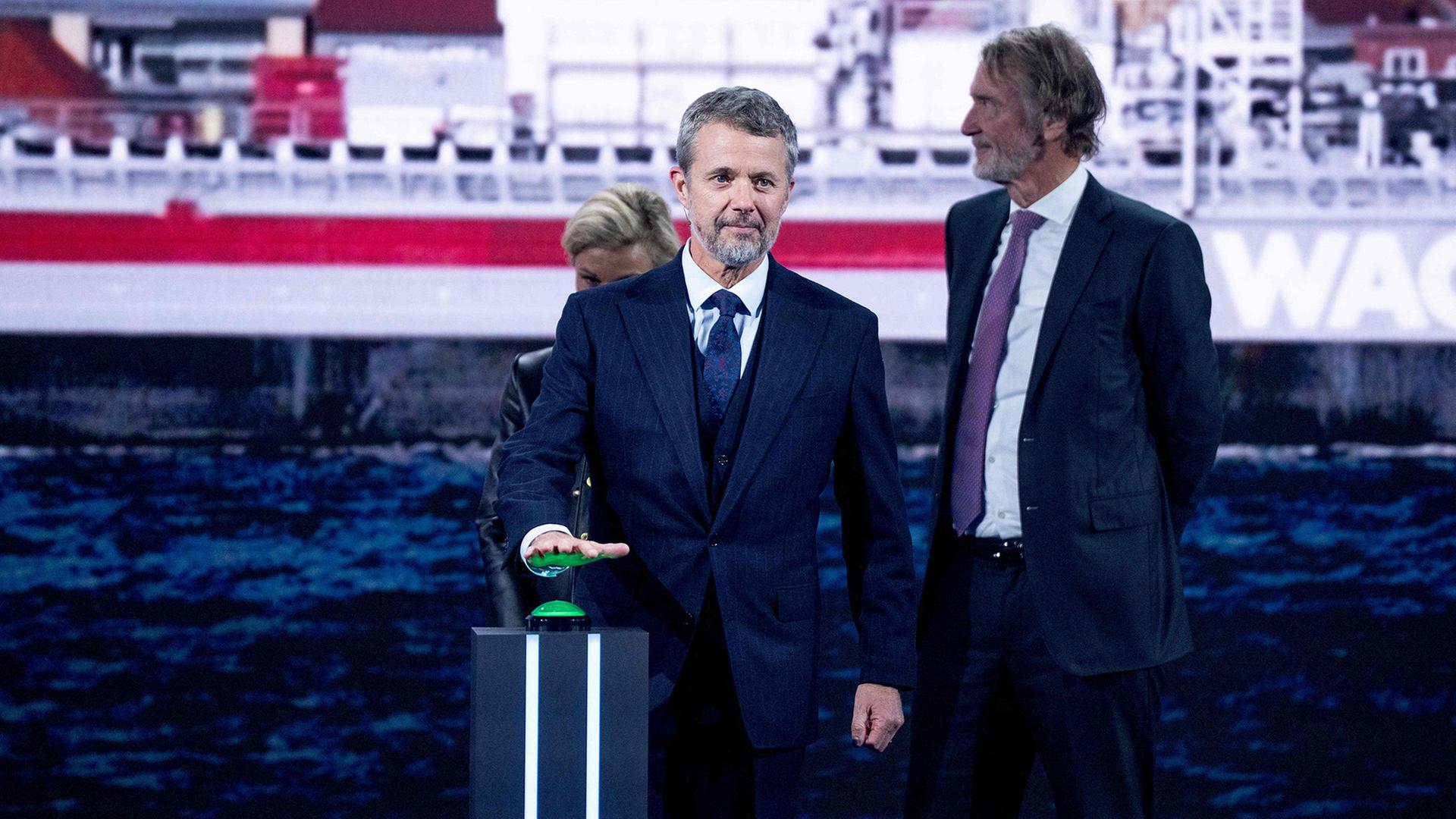
King Frederik of Denmark presses the start button. It is the signal for a ship in the harbour of the city of Esbjerg. On board are several tanks containing more than 5,000 tonnes of liquefied CO2. The destination is a former oil field far off the Danish coast. Here, the liquefied CO2 is to be permanently stored beneath the seabed.
David Bucknall, head of the company Ineos Energy responsible for the project, explains: "Our vision is for others to learn from our project. We believe this project will be the first of many. We are very proud to be the first company in the EU to deploy this technology on a commercial scale."
CO2 can be transported by ship in liquid form
This underground storage of CO2 is intended to make European industry less harmful to the climate. Until now, the situation has generally been that when CO2 is produced in a factory, it ultimately ends up in the atmosphere, thereby harming the climate. The Greensand project aims to change this: the CO2 is first captured, then liquefied, and subsequently transported by ship out into the North Sea. There it is pumped into a former oil field beneath the ground, where it remains.
The EU is also counting on this so-called CCS technology and has invested in the Greensand project. Dan Jørgensen, EU Commissioner for Energy, backs the process: "It is very good for the climate that we can now demonstrate that this technology is feasible. The Intergovernmental Panel on Climate Change has clearly stated: if we fail to remove CO2 from the atmosphere, we cannot achieve our climate targets."
A false incentive for industry?
The EU aims to become climate-neutral by 2050. At the same time, however, the economy is not to be overly restricted. Capturing and storing CO2 could be one way to reconcile the interests of industry and climate protection, says Ineos Energy chief Bucknall. "If we want to continue having an industry and manufacturing products in Europe, we will produce emissions — regardless of how efficient we become." For these emissions, industry needs carbon storage technology.
Critics argue, however, that such projects could create a false incentive, because the real goal should be to avoid producing CO2 in the first place. Philip Fosbøl from the Technical University of Denmark has been researching CO2 storage for years and finds that: "Unfortunately, there are other countries in the world that could also use this technology in a negative way. That means they use it simply to continue maintaining oil and gas production." In his view, however, Denmark and Europe would remain committed to climate protection.
For such projects to succeed in the long term, many companies need to participate and store their CO2. So far, only companies from Denmark and Sweden are involved in Greensand. According to the operator, however, there are also interested parties from Germany. In the steel, cement and chemical industries in particular, it will be virtually impossible to avoid CO2 emissions for the foreseeable future.
Greensand only solves part of the problem
But how safe is it actually to simply pump CO2 into empty oil and gas fields? CO2 researcher Fosbøl draws parallels to oil and gas extraction. "Storing CO2 is just as safe as previously extracting oil or gas from the subsurface. We take CO2 and bring it back, so to speak, to where its creators originally came from – underground, into the reservoirs where oil and gas were locked away for millions of years."
He assumes that the Greensand project alone can store CO2 underground for several decades. But one thing is also clear: it can only be part of the solution in the fight against climate change.