Infections in the vicinity of Frankfurt Airport: Mosquito protection advised following malaria cases
Two people have contracted malaria in the vicinity of Frankfurt Airport. They were apparently bitten by imported mosquitoes. According to experts, however, the risk of further infections is low.
Two people have contracted malaria in the vicinity of Frankfurt Airport, as the Frankfurt Health Authority announced at the beginning of the week. Both live in the Frankfurt district of Schwanheim and do not work at the airport. They had also not recently been to a malaria risk area.
The health authority therefore suspects that the disease was transmitted by an imported Anopheles mosquito. Back in July, six Frankfurt Airport employees had already contracted malaria, two of whom died.
How did the two new cases come to light?
A laboratory informed the Frankfurt Health Authority of the positive malaria tests. Laboratories are legally required to do so. The health authority did not disclose why the two individuals were tested for malaria or what symptoms they had. They are currently receiving inpatient treatment. No further details about them or their condition were provided. The precise circumstances are still being investigated – including whether there is a connection to the previous six malaria cases.
What is airport malaria?
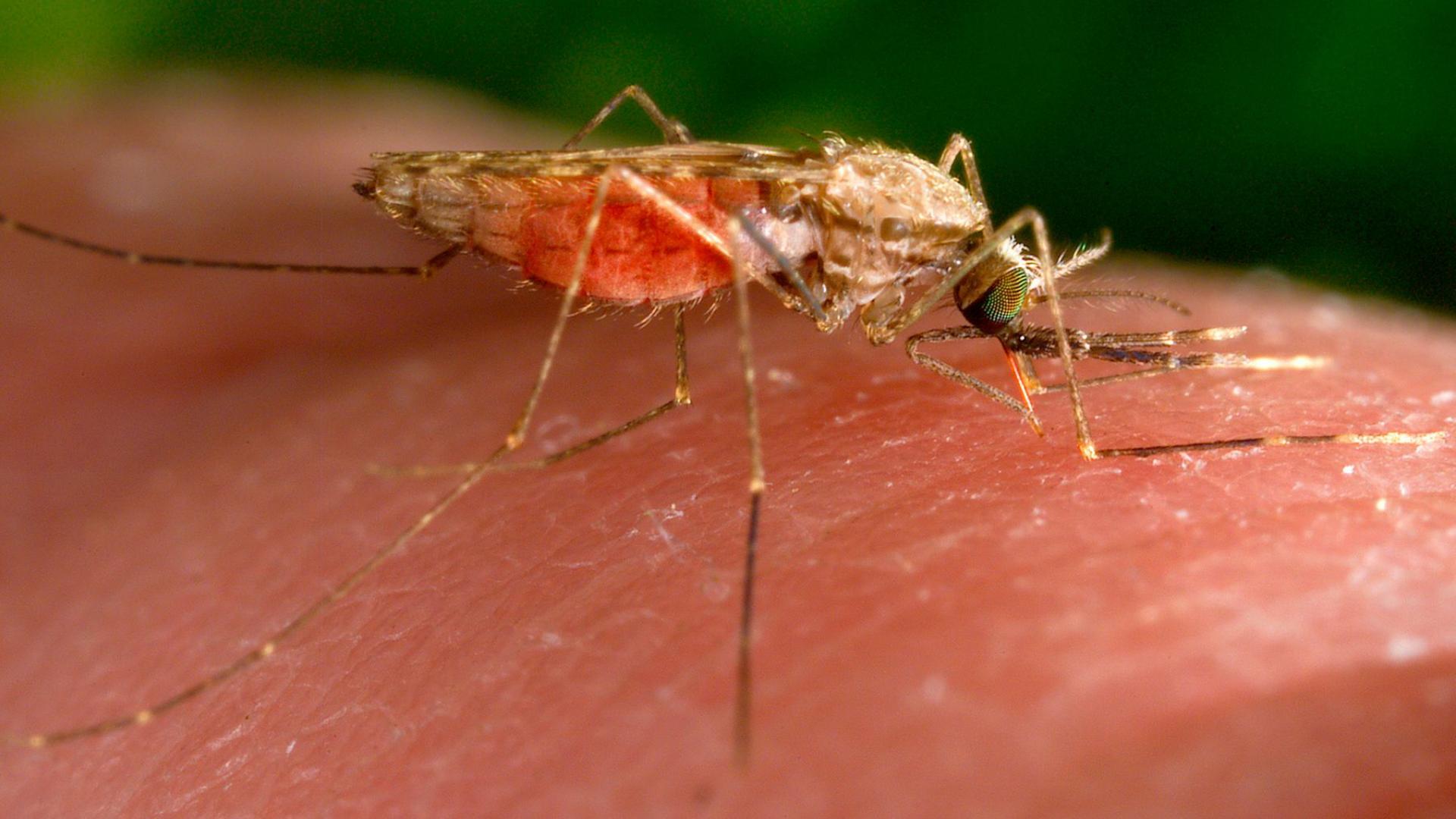
Malaria is transmitted through the bite of female Anopheles mosquitoes. The mosquitoes are found primarily in tropical and subtropical regions. The most severe form, Plasmodium falciparum malaria, can be life-threatening.
Airport malaria refers to cases where an infected mosquito from a malaria risk area reaches Germany, for example aboard an aircraft or in cargo, and bites a person there.
Such cases are very rare. According to a study, only 105 cases of airport malaria across the whole of Europe are recorded in databases from 1969 to early 2024. There were also 32 cases of so-called baggage malaria, where an infected mosquito had been transported in luggage and the site of infection was far from an airport.
The last case at Frankfurt Airport prior to the current cluster was documented in 2023. Malaria is treatable; what is crucial is that the disease is detected early.
In rare cases, Anopheles mosquitoes travel along too.
How great is the malaria risk in Schwanheim?
According to the Frankfurt Health Authority, it is very low. Besides the two known cases, there are currently no further suspected cases.
The fact that mosquitoes move around an airport within a radius of several kilometres is extremely rare, says the authority's director Tinnemann. "You have to imagine how you feel after a long journey from a tropical country – you are exhausted." Transmission from person to person is not possible.
What precautionary measures are necessary?
Those with particular concerns can turn to "mosquito protection through repellents and covering clothing," the health authority states. Repellents are substances that keep mosquitoes away through scents and are available, for example, in the form of sprays.
Additionally, mosquito protection in living spaces – for example through fly screens – can minimise the risk of being bitten, the authority says. Overall, however, the risk is very low.
How far can Anopheles mosquitoes fly?
Normally, mosquitoes travel about one to two kilometers, says tropical medicine specialist Benno Kreuels from the University Medical Center Hamburg-Eppendorf and the Bernhard Nocht Institute for Tropical Medicine. Under favorable wind conditions, significantly greater distances of up to around ten kilometers are also possible.
The two current cases were registered in Schwanheim, approximately five kilometers from the airport, according to the health authority.
However, the mosquitoes do not necessarily have to fly from the airport to their destination themselves: they can also be transported in luggage or cargo, for example, and only emerge at their destination.
Mosquitoes can transmit malaria, among other diseases.
Are mosquitoes being examined around Schwanheim?
The health authority has set up mosquito traps at the airport and around the residences of the two patients. According to the authority, the captured mosquitoes are being genetically analyzed at the Tropical Institute in Antwerp, Belgium.
This is intended to determine, among other things, which species they belong to and where they come from. So far, according to the health authority, no Anopheles mosquitoes have been found.
Could the mosquitoes still be alive?
That cannot be said with certainty, according to the health authority. It is also unclear whether the two people were bitten by the same mosquito or by different ones. Given the incubation period of 7 to 15 days, it is unlikely that the mosquitoes are still alive in the Rhine-Main region.
Normally, the transmitting Anopheles mosquitoes survive only two to a maximum of three weeks in their native habitat, says tropical medicine specialist Kreuels. These mosquitoes could reach that lifespan even in the German midsummer — especially when temperatures are as high as they are this year.
Can the mosquitoes reproduce in Germany?
According to experts, it cannot be ruled out. A short-term reproduction is theoretically possible, according to Kreuels. For this to happen, a female mosquito would have to survive the flight and already be carrying eggs, or mate with a male here.
However, the tropical medicine specialist considers it unlikely that the mosquito would establish itself permanently in Germany. Even in warmer parts of southern Europe, there are as yet no native Anopheles populations.
Will climate change lead to more cases in the future?
Airport malaria could occur more frequently in part because temperatures are rising. A hot summer increases the likelihood that imported mosquitoes will survive longer in Germany, says Kreuels.
The number of documented cases in Frankfurt has already risen: between 1990 and 2010, one case was recorded; in the twelve years that followed, there were five. However, Kreuels identifies not climate change but increasing air traffic as the most likely primary cause — particularly flights from countries with high malaria prevalence such as Cameroon, Ghana, and Nigeria.
Climate change can also increase the number of malaria cases in the regions of origin. As a result, more infected mosquitoes could reach Germany.
Can native mosquitoes also transmit malaria?
Theoretically, yes. There are Anopheles species in Germany that are in principle capable of acting as vectors.
A corresponding suspicion arose in 1997 in North Rhine-Westphalia. There, two girls contracted malaria in a hospital. The pathogens were likely transmitted by a native mosquito species that was found near the Duisburg clinic.
At the same time, a girl from Angola was being treated there for malaria. A mosquito presumably bit her first and then the two girls. That is at least one hypothesis.
What should people in the vicinity of the airport look out for?
Frankfurt's public health office is calling on residents as well as doctors to consider airport malaria when symptoms arise. The diagnosis can be made using a rapid test.
Possible symptoms include:
- Fever
- Chills
- Headaches
- Confusion
- Seizures
- Breathing difficulties
In general, "Frankfurt residents are not at risk from malaria," Tinnemann had already emphasized on Monday. He described it as an "exceptionally rare event." Nevertheless, the public health office has set up a telephone hotline at 069/212-30030 where residents can obtain information.